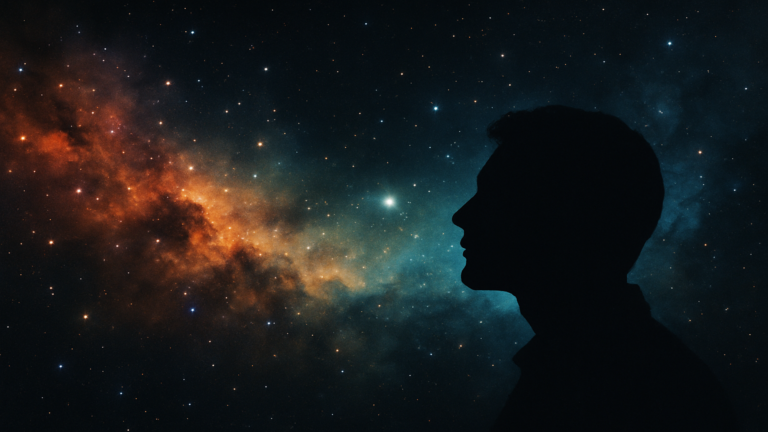
There are those who dedicate their lives to understanding the universe as though it were a clock—an intricate, ancient mechanism, forged not by hands but by the silent unfolding of space and time.
In a quiet workshop tucked between mountains and clouds, a solitary figure works. sullen-faced, deliberate, with fingers smudged by time and ink, this is the clockmaker of science. He has spent decades studying the turning of the cosmic gears. He maps orbital mechanics like a cartographer of time. He traces the eddies of gravity, the pulse of neutrinos, the silent screams of collapsing stars. His tools are equations, his compass a telescope, his ink the fading light of quasars. Every cog he uncovers, every wheel he deciphers, tightens the fit of his understanding.
To him, the universe is not unknowable. It is merely unfinished.
He is slow, methodical. To some, he seems maddeningly patient. He waits for light that left its star before our ancestors discovered fire. He catalogues, classifies, corrects, refines—turning chaos into clarity. If the universe is a timepiece, then he is its careful steward, one brass gear at a time.
But there is another kind of scientist.
The Oracle.
She does not live in observatories. She walks forests in twilight. She paints abstract shapes in notebooks beside half-sipped coffee. She may lack formal letters after her name, but she sees patterns not in data, but in dreams.
The Oracle looks at what everyone else has looked at and sees what no one else has seen. She draws spirals in the sand and sees galaxies. She closes her eyes and feels time not as something that ticks, but something that breathes.
She is rarely taken seriously at first. There are no footnotes in her speech, no citations in her heart. And yet, some of the greatest leaps in science began not with certainty, but with the audacity to wonder wildly.
They worked in parallel—he with his silent mechanisms, she with her glances into the infinite. He watched her with wary respect, curious how someone could skip the necessary rigor and arrive at possibility. She watched him with admiration veiled as frustration, wondering how someone could walk so slowly toward truths that danced in plain sight.
One evening, he invited her to the workshop.
He showed her a pendulum that could count the seconds of the cosmos. A gyroscope that mimicked the spin of neutron stars. A gear etched with the ratios of hydrogen to helium. She listened, eyes wide not in comprehension, but reverence.
Then she placed a small drawing on his desk.
It was a swirling set of curves—rough, unmeasured, chaotic. But hidden within was a solution to a problem he had laboured on for years. Not derived. Imagined. She had traced the answer in metaphor, not in method. And it worked.
There was silence between them.
A kind of awe.
Because suddenly, they understood.
He, the clockmaker, had spent his life carving the walls of knowledge, stone by stone, up a towering mountain.
She, the oracle, had floated over them—unaware they were there.
Science has always been this strange duet: discipline and daring. Order and vision.
Newton saw an apple fall, but also heard in that simple thud the whisper of a universal law. Einstein imagined riding a beam of light long before he had the mathematics to describe it. Jocelyn Bell Burnell heard the ticking of a cosmic lighthouse and saw not noise, but signal. The oracles are not always right. But neither is the clockmaker immune to error. Both are essential.
One anchors us in what is known. The other stretches us into what might be.
We live in a universe that is both lawful and lyrical. One where gravity obeys precise equations, but black holes sing in gravitational waves. Where particles entangle in ways we cannot yet fully explain, and time bends softly around mass like linen drawn over a sleeping form.
The clockmaker gives us certainty.
The oracle gives us possibility.
And sometimes, if we are very lucky, they meet.
In the quiet hours, after the noise of peer review and skepticism has faded, there are conversations between stars. Between scientists. Between those who build and those who dream. The most profound truths often begin in these unlikely unions. And in the convergence of precision and poetry, the universe leans forward to whisper its next secret.
The astronomer adjusts his lens.
The oracle tilts her head to listen.
And somewhere, in the infinite ticking of time, a new kind of clock begins to beat—one whose pendulum swings between imagination and understanding, theory and truth, the known and the almost-known.
A clock not built by either alone.
But by both.
Together.
Because in the end, the clockmaker may know every spring, every cog, every hidden escapement of the mechanism…
But the oracle?
She can tell you the time.
And more importantly—She can tell you why it matters.