
- Latin enabled international scientific communication - It allowed scientists across Europe to read each other's work for the first time, accelerating scientific progress.
- It created exclusivity - Latin locked out anyone without classical education from participating in scientific discourse.
- Its legacy persists today - Though replaced by English, Latin still appears in scientific names and medical terms, and the same language barrier issues remain.
Picture this: It's 1687, and Isaac Newton has just finished writing the most important scientific book in human history. Principia Mathematica will revolutionize how we understand gravity, motion, and the very fabric of the universe. But here's the thing—Newton writes the entire groundbreaking work in Latin, a language that had supposedly been "dead" for over a thousand years.

Fast-forward fifty years to the 1730s. Carl Linnaeus, the brilliant Swedish botanist who will give every living thing on Earth its scientific name, travels to London to meet fellow scientists at the prestigious Royal Society. He's excited to discuss his revolutionary classification system with the great minds of English science. But after his visit, Linnaeus complains in his diary that the English scientists "don't know Latin properly."
Here's the twist: they were probably all speaking Latin—just with completely different accents! Swedish Latin sounded nothing like English Latin, which sounded nothing like Italian Latin. Yet somehow, this "dead" language had become the most alive language in all of science.
Why did a language from ancient Rome become the universal tongue of telescopes, microscopes, and mathematical equations?
Europe's Great Communication Crisis
To understand why Latin conquered science, you need to picture medieval Europe as a Tower of Babel. Imagine you're a brilliant natural philosopher in 1500s Germany, and you've just discovered something that could change medicine forever. You want to share it with the world, but "the world" speaks dozens of completely different languages.
Your groundbreaking discovery, written in German, would be meaningless to scholars in France, Spain, Italy, or England. There were no Google Translate apps, no international conferences with simultaneous interpretation. A revolutionary idea could literally die within a few hundred miles of where it was born, simply because nobody else could read about it.
This wasn't just inconvenient—it was catastrophic for human progress. Knowledge was trapped in linguistic prisons.
Enter Latin, the unexpected hero of the Scientific Revolution.
The Accidental Solution
Latin didn't become the language of science through some grand planning committee. It happened almost by accident, thanks to one institution that had already connected all of Europe: the Catholic Church.
For over a thousand years, the Church had been Europe's educational system. If you learned to read and write anywhere in medieval Europe—from Ireland to Poland, from Scotland to Sicily—you learned in Latin. It wasn't just that you studied Latin as a subject; everything was taught in Latin. Mathematics, philosophy, law, medicine, astronomy—if you went to school, you lived in Latin for years.

Picture a typical medieval classroom: Boys (and it was only boys) would arrive speaking their local language—German, French, English, whatever. But from the moment they walked through the school doors, they could only speak Latin. Get caught speaking your native tongue? You'd be punished. Your textbooks were in Latin. Your teachers lectured in Latin. You even had to ask permission to use the bathroom in Latin.
This might sound harsh, but it created something unprecedented in human history: a generation of scholars who could all communicate with each other, no matter where they were born.
The Communication Revolution
By the time the Scientific Revolution began in the 1500s, Latin had already solved Europe's communication crisis. Any educated person could read and understand any other educated person's work, regardless of their nationality. This created the world's first truly international scientific community.
The impact was revolutionary. Scientists could finally "stand on the shoulders of giants"—Newton's famous phrase about building on previous discoveries wasn't just poetic. It was literal. He could read the work of Italian physicists, German mathematicians, and Polish astronomers, all in the same language. For the first time in history, human knowledge could accumulate instead of getting lost in translation.
Consider what this meant: When Galileo pointed his telescope at Jupiter's moons in Italy, astronomers across Europe could immediately understand and verify his observations. When Kepler discovered the laws of planetary motion in Germany, mathematicians in France could build on his work. The printing press was spreading books faster than ever, but only Latin made sure those books could be understood everywhere.
When Accents Nearly Broke Science
But Latin as a spoken language? That was a different story entirely.

Carl Linnaeus's frustrating trip to London perfectly illustrates the problem. The Swedish naturalist had mastered written Latin—he could read ancient Roman texts as easily as a newspaper. But when he tried to have conversations with English scientists, communication broke down completely.
It wasn't that the English didn't know Latin. Sir Hans Sloane, whom Linnaeus accused of being ignorant, was actually a brilliant scholar who had read Latin texts for decades. The problem was pronunciation. Swedish Latin sounded completely different from English Latin. Italian Latin had its own accent. German Latin followed different rules.
Imagine if everyone in the world could read English perfectly, but Americans, Australians, Indians, and Nigerians all pronounced it so differently that they couldn't understand each other when speaking. That was Latin in the 1700s.
This reveals something fascinating about how scientific knowledge spreads: written communication was far more important than spoken communication. Scientists were building a republic of letters, not a republic of conversations. As long as they could read each other's published work, science could advance.
The Secret Language of the Elite
Latin didn't just solve communication problems—it created social ones. By requiring Latin literacy, science automatically excluded anyone who hadn't received a formal classical education. This wasn't a bug in the system; for many, it was a feature.
Latin became a marker of intellectual and social status. If you could write in Latin, you belonged to the educated elite. If you couldn't, you were locked out of scholarly discourse entirely. This had profound implications for who could participate in creating knowledge.
Doctors were particularly fond of using Latin as a professional secret language. When a physician wrote "the prognosis is infaust," they were essentially telling the patient's family to start planning a funeral—but in a way that maintained professional dignity and mystique. Latin medical terminology served as a barrier between professional expertise and common understanding.
The exclusivity wasn't entirely intentional, but it was certainly convenient. Science in Latin was science for the few, by the few.
The Rebels Who Broke the Rules
Not everyone was happy with Latin's monopoly on scientific truth. Some scientists began pushing back, and their rebellions tell us a lot about the social tensions surrounding scientific language.
Galileo Galilei was one of the first major scientific rebels. While he wrote his technical astronomical works in Latin for his scholarly peers, he also published some works in Italian. His Dialogue Concerning the Two Chief World Systems, which defended the controversial idea that Earth revolves around the Sun, was written in Italian specifically to reach a broader audience.
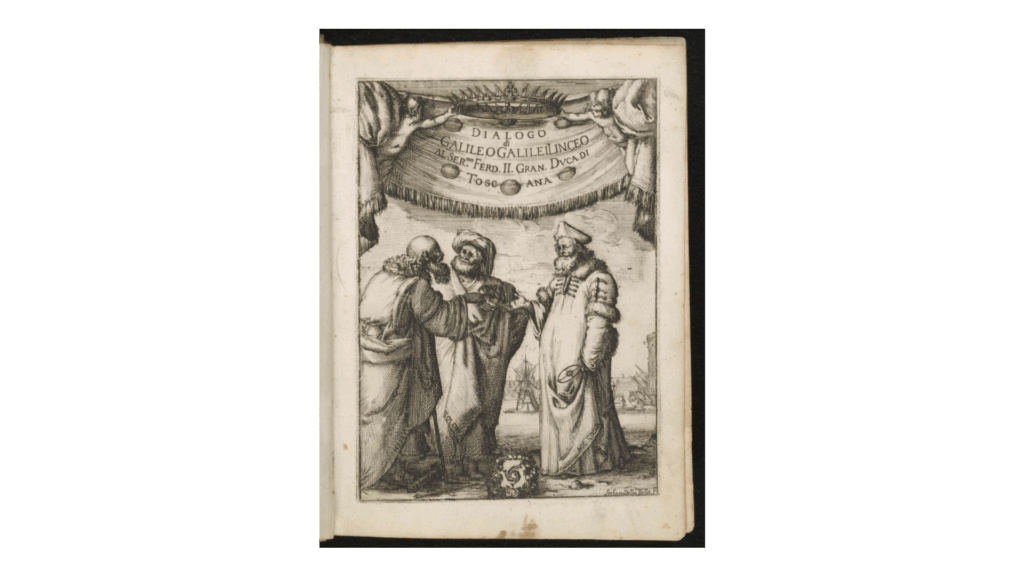
This created a scandal that went far beyond astronomy. By writing about cosmic questions in the vernacular, Galileo was implicitly arguing that ordinary people—not just Latin-educated elites—deserved to understand how the universe worked. The choice of language became a political statement about who deserved access to knowledge.
The Catholic Church's reaction was swift and harsh. They banned the book and put Galileo under house arrest, officially for his astronomical ideas but partly because he had dared to discuss sacred cosmic truths in common Italian rather than scholarly Latin.
The Beginning of the End
By the 1700s, cracks were appearing in Latin's scientific empire. Several forces were working against the ancient language:
National Pride: Countries began wanting their own languages to be prestigious. French became the language of European diplomacy and culture. German became associated with philosophical depth and precision. English rode the waves of British naval and economic power.
Vocabulary Problems: Latin struggled to keep up with rapid scientific advances. How do you create a Latin word for "electricity" when the Romans never dreamed of such a concept? Scientists found it increasingly awkward to describe new discoveries in an ancient language that lacked modern technical vocabulary.
Educational Changes: As education expanded beyond the elite, more people needed access to scientific knowledge. Latin literacy was declining just as scientific literacy was becoming more important for engineers, doctors, and inventors.
The Democratic Push: Enlightenment ideals emphasized that knowledge should serve humanity, not just scholars. This philosophical shift made Latin's exclusivity seem increasingly outdated and morally questionable.
Newton himself embodied this transition. His early masterwork, Principia, was written in Latin to reach the international scholarly community. But his later works were published in English, reflecting both his growing confidence in English as a serious intellectual language and the changing expectations of his audience.
Why Latin Never Really Dies
Despite losing its dominance, Latin never completely disappeared from science. Walk into any biology classroom today, and you'll still hear it everywhere:
Every living thing on Earth has a Latin name. Homo sapiens (humans), Tyrannosaurus rex (the famous dinosaur), Rosa rubiginosa (the sweet briar rose)—regardless of what language you speak, these scientific names are the same worldwide. A Chinese botanist and a Brazilian botanist can discuss Helianthus annuus (sunflowers) with perfect mutual understanding.

Medical terminology remains stubbornly Latin. When doctors talk about "cardiovascular disease," "pulmonary embolism," or "neurological symptoms," they're speaking the same language their medieval predecessors used. This isn't just tradition—it's practical. Medical Latin provides precision and universality that vernacular languages can't match.
The naming continues. When scientists discover new species, elements, or phenomena, they often give them Latin names. The newest elements on the periodic table have Latin-derived names like "flerovium" and "moscovium." Latin remains alive because science needs a universal vocabulary.
The English Empire Strikes Back
Today, English has largely taken over Latin's role as the universal language of science. Walk into a scientific conference in Tokyo, São Paulo, or Stockholm, and you'll hear researchers presenting in English, regardless of their native language. Scientific papers are overwhelmingly published in English. English is the new Latin.
But this transition has recreated many of the same problems Latin once caused:
Language Barriers: Scientists whose first language isn't English face significant disadvantages in publishing and presenting their work. Brilliant research might be overlooked simply because it's harder for non-native speakers to write compelling English prose.
Cultural Dominance: English-language scientific journals and institutions set global research priorities, potentially marginalizing scientific traditions and approaches from other cultures.
Access Issues: Just as Latin once excluded those without classical education, English now excludes those without access to English-language education.
The Democratic Question: Are we repeating the same mistakes, creating a new scientific elite based on language skills rather than scientific insight?
Technology to the Rescue?
Unlike scientists in Newton's era, we now have tools that might solve the language problem entirely. AI translation is becoming remarkably sophisticated. Real-time translation apps can already handle basic scientific conversations. Machine learning systems are getting better at translating technical papers while preserving scientific precision.
Could technology finally create the universal scientific communication that Latin once promised? Imagine a world where a researcher in Nigeria could publish in Yoruba, and colleagues in Germany could read it instantly in perfect German, while scientists in Japan access the same work in flawless Japanese.
We're not there yet, but we're getting closer. Some scientific journals are experimenting with AI-translated abstracts in multiple languages. International conferences are testing real-time translation systems.
An Anthropological Lesson
The story of Latin in science reveals something profound about how human knowledge spreads—and how it gets blocked. Language is never just about communication; it's about power, access, and identity.
When we choose a scientific language, we're making decisions about who gets to participate in humanity's greatest intellectual adventure. Latin connected minds across medieval Europe but excluded everyone else. English connects researchers globally today but may marginalize non-English speaking communities.
Every language choice in science is simultaneously inclusive and exclusive. It brings some people into the conversation while keeping others out. Understanding this history helps us think more carefully about the language choices we make in science today.
Whether you're a student, educator, or simply someone curious about how the world works, Latin's scientific legacy touches your daily life:
- When you hear medical terms, you're listening to echoes of medieval university lectures conducted entirely in Latin.
- When you see scientific names for plants and animals, you're witnessing the survival of the world's most successful scientific language standardization project.
- When you struggle to access scientific information because of language barriers, you're experiencing the same frustrations that drove scientists to adopt Latin in the first place.
The next time you hear someone dismiss Latin as a "dead language," remember: it's the language that made modern science possible. Latin didn't just preserve ancient Roman culture—it created the infrastructure for human beings to understand the universe together.

And in our increasingly connected but linguistically diverse world, the questions Latin raised about scientific communication are more relevant than ever: How do we share knowledge across language barriers? Who gets to participate in scientific discovery? How do we balance efficiency with inclusivity?
The answers we choose will shape the future of human knowledge itself.
Further Reading
- Waquet, Françoise. Latin: or, The Empire of a Sign: From the Sixteenth to the Twentieth Centuries. London: Verso, 2001.
- Gordin, Michael D. Scientific Babel: How Science Was Done Before and After Global English. Chicago: University of Chicago Press, 2015.
- The NOSCEMUS Project Database: Nova Scientia. Early Modern Scientific Literature and Latin [Digital archive of scientific texts in Latin]
- Burke, Peter. Languages and Communities in Early Modern Europe. Cambridge: Cambridge University Press, 2004.
- Leonhardt, Jürgen. Latin: Story of a World Language. Cambridge, MA: Harvard University Press, 2013.
- Dear, Peter. Revolutionizing the Sciences: European Knowledge and Its Ambitions, 1500-1700. Princeton: Princeton University Press, 2001.
- Amano, Tatsuya, et al. "Languages Used in Science Are Severely Biased towards English." PLOS Biology 14, no. 12 (2016).