In January of 2004, on a barren plain called Meridiani Planum, a small machine awoke beneath an alien sky. It was no larger than a golf cart, a frail machine of metal and wire, yet strong enough to shoulder the hopes of a civilisation. Its name was Opportunity. Its mission was simple, almost modest: survive for ninety Martian days, no more, no less, and in that time scratch the surface of a world that had been silent for billions of years.
But ninety days became fifteen years.
For more than five thousand sunrises, Opportunity opened its eyes to a desert of endless dust and silence. It travelled over forty-five kilometres, farther than any emissary had ever roamed across the surface of another world. It climbed ridges that towered above it like mountains, peered into craters carved in cataclysms older than life on Earth, and weathered winters so cold that its circuits might have frozen solid.
And in its patient wanderings, it found treasures. Rocks laced with hematite — tiny spheres forged in liquid water. Ancient sediments laid down in a time when rivers once flowed, when perhaps seas stretched across the Martian horizon. Proof, at last, that this was not always a world of deserts and storms. Mars, in its youth, had been a planet of possibility.
All this, from a machine built for ninety days.
Each sunrise was a victory. Each faint signal that threaded its way across two hundred million kilometres of space was a reminder that our fragile envoy still lived, still carried our curiosity into the wilderness, still whispered to us that it endured.
But Mars is not a gentle host. Its atmosphere is thin, its cold merciless, its storms vast enough to swallow continents. And in the summer of 2018, the sky began to change. Dust lifted from the plains and rose into the stratosphere, until the planet itself vanished beneath a shroud. For weeks, there was no day, only twilight.
Opportunity’s lifeline was sunlight. Its heart was powered by a battery charged by the rays of a distant star. And as the storm grew, that lifeline was severed. The light faded. The charge ran low.
Its last transmission to Earth was stripped of poetry — a fragment of telemetry, data without embellishment. But when translated into words, it became something achingly human: “My battery is low, and it’s getting dark.”
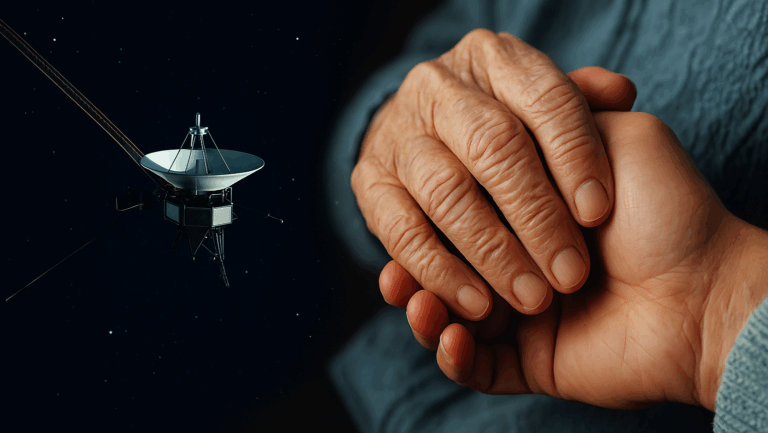
The rover did not know it was dying. It did not fear the dark. Yet in that final message we heard our own reflection. For what is a human life if not the same? We, too, wander for a while beneath the borrowed light of a star. We, too, stretch our days farther than we imagined possible. We, too, make discoveries, endure hardships, leave our tracks upon the dust. And one day, our own batteries run low. One day, it too will grow dark.
This is why Opportunity’s long goodbye pierced so deeply. It was never just about a machine falling silent. It was about us. About the fragile tenacity of beings who dare to explore, who push their light as far as it will carry them, who face the storms with no guarantee of survival.
Think of it: a machine designed for three months lived for fifteen years. It multiplied its life a hundredfold. It left tracks that will endure on Mars long after every stone of our own cities has crumbled. Long after we ourselves are gone, its path will still cross that alien desert — a testimony that once, in a distant age, a species on a pale blue dot reached out and touched another world.
And then, one day, it fell silent. Not in defeat, not in despair, but simply in exhaustion. A whisper across the void: my battery is low, and it’s getting dark.
Not an ending, but a monument. Not silence, but legacy. For what matters is never how long the light lasts, but how brightly it shines while it is here.
That is the story of Opportunity.
That is the long goodbye.