



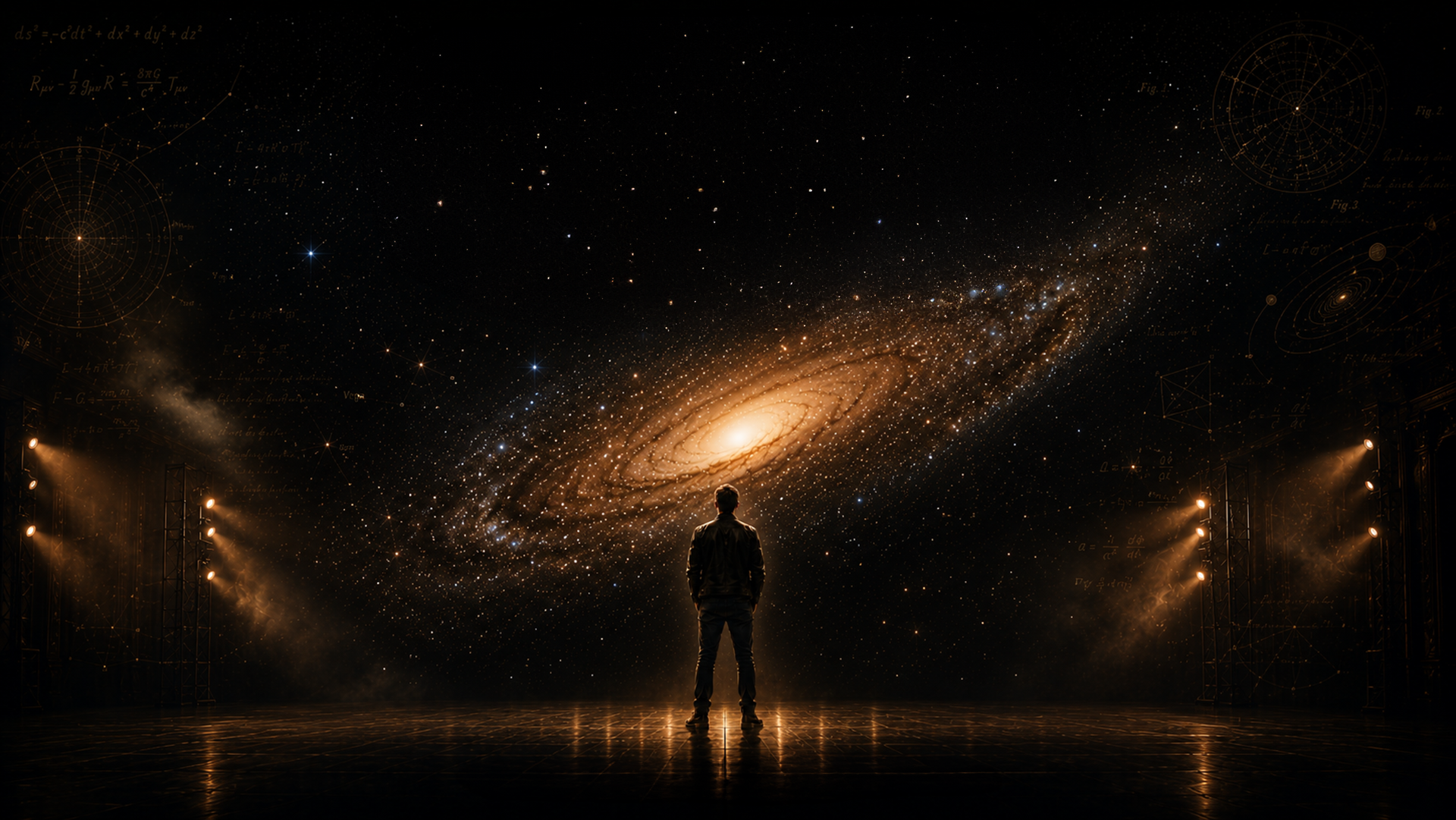


On stage in Wonders of Our Universe, and again in my book, I say something that has followed me since childhood.
I am not fascinated by numbers, I am fascinated by what lives in the gaps between them.
Most of us learn to count before we learn to read. One, then two. A finger, then another. The class repeats in chorus, the room smiles, the lesson moves on. But the real lesson begins in the space we just stepped over.
Stand at one and look toward two. That small span looks harmless. It is not. Inside it there are more points than counting can hold. Fractions sit everywhere, halves and quarters and thousandths that never run out. Yet taken together the fractions occupy no length. Almost every point between one and two is not a fraction at all. Most are irrationals that refuse to be written as a neat ratio. The marks on the ruler are landmarks. The landscape is the continuous room between them.
Science learns to speak in that room. Nature does not jump cleanly from one to two. Change lives inside the interval. Calculus is the discipline of paying attention there. You ask what happens as the gap becomes small, then smaller, then smaller again. You never quite reach zero, and you do not need to. The limit lives inside the approach. From that one idea come the smooth curves that carry the laws of motion, the way speed becomes acceleration, the way pressure becomes flow, the way a signal fades and a planet turns.
There is a plain promise here that lets us trust the world. If a quantity varies without breaks, it cannot skip. Give its value at one and at two, and somewhere in between it must take every value in between. A tide that is low now and high later must meet every level on the way. A planet that is north of a line and later south of it must cross the line. That promise lets us solve for a crossing and arrive. It lets a careful scan across a control dial find the exact point where an instrument truly balances. The interval forbids magic and requires honesty.
The same room carries quiet information. If a curve is smooth, there is at least one point inside the span where the instant matches the average. Somewhere between one and two the world equals its own mean. That is why sampling can stand for reality when it is done with respect. It tells us that an honest average is not a guess. It is a promise kept by the interval.
You can see the power of a gap with your own eyes. Spread white light into colour and you will find hair-thin dark lines crossing the band, missing light, places where atoms kept their share. Those small absences do the talking. From what is not there we read what is present: the elements at work, the temperature, the motion. A smooth law connects energy and wavelength, and still the spectrum speaks in fine gaps, and the gaps carry the facts. The room between one and two gives the language for that reading. It is where a slope becomes a number. It is where a tiny difference becomes information.
Even our humility as scientists comes from this room. Every measurement is a value and a width. We draw a small bar around a number because truth lives in a range, not on a pin. That width is not an apology. It is an address for the next experiment. We shrink it, then shrink it again, and each time the interval answers with more structure than yesterday. The gap refuses to vanish, and that refusal is what keeps understanding alive.
All of this begins with the first steps we took as children. One, then two. From a distance those steps look small. In mathematics they hide an infinity. Between any two marks inside that span there is another gap. Between those, smaller gaps. You can reduce the space without limit. You cannot remove it. The interval survives every approach. That stubborn survival is not a flaw in our language. It is a property of a world that allows continuity, growth, and choice. It is the room in which a curve can carry a law, and a mind can change its view.
We love to remember the words from the 1969 Moon landing: “That’s one small step for man, one giant leap for mankind.” A foot moved from a ladder to dust and history changed. Counting from one to two looks just as simple, a small step anyone can take. But in this case the leap is not giant, it is endless. The room between one and two contains infinitely many rooms, and each of those contains more. Armstrong spoke both poetically and truthfully from Mare Tranquillitatis. That small step did stand for a giant leap, but the space between was carried by thousands of minds working long hours for many years. The room between one and two is an even larger challenge that we often overlook precisely because the “small step” is so easy that even a pre-school child can take it alone.
So come back to it with me. One, two, and then pause. The gap between is not silence. It is a field where laws act and where meaning gathers. It is where the kettle warms by every degree on its way to your morning coffee, where a tide keeps every appointment from low to high, where missing lines in a rainbow tell you which atoms are at work. It is where science turns from counting to understanding.
Here is my confession, and my invitation. I never really moved past that first lesson as a child. I realised very early that something far larger was hiding in that small space, and it has been calling to me ever since. The room between one and two is a wonder of our universe all by itself. I think about it often, as a scientist and as a person. Each time I look carefully, the room gives back more. There are lifetimes of work in that span. There are treasures waiting to be found in there. And if we learn to linger in the step almost everyone skips, we may discover that the small step we took as children is also our greatest leap.