Over 500 species of sharks inhabit our oceans, and represent a 400 million year legacy. They might be most well-known as powerful, high-speed predators, but their long evolutionary history has allowed sharks to diversify into an astonishing variety of forms and lifestyles, thanks to some otherworldly adaptations and abilities.
Sharks and their close relatives, the rays & chimaeras, are unusual among modern vertebrates in that their skeletons are not made of bone, but cartilage; the pliable, gristly tissue that gives our ears and nose their shape. Cartilage is considerably lighter than bone, and much more flexible, allowing sharks greater speed and flexibility than similar-sized bony fish, as well as greater resistance to the pressure exerted on their bodies by deep water.
This heightened agility however comes at a cost. Being flexible means that cartilage is a less efficient transmitter of muscle motion than bone; imagine pulling a lever made of rubber. There is also a health risk that comes with a cartilaginous skeleton. The role of bone marrow in producing red blood cells means that bone tissue itself is highly vascularised; filled with blood vessels that allows for easy transmission of nutrients. Cartilage does not have this same blood supply, meaning that injuries to it can take up to twice as long to heal as they would on equivalent bone.
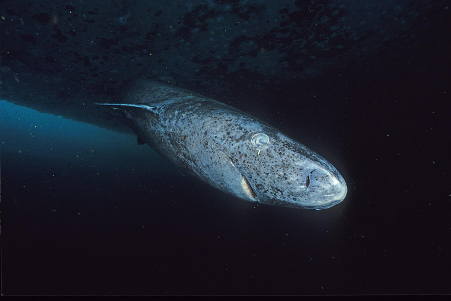
The most calcified parts of a shark’s skeleton are its jaws and teeth. Like many fish, the jaws of most shark species are not affixed to their skulls, but hinged as separate components, allowing them to distend and expand to help them reach their prey.
The Tiger Shark (Galeocerdo cuvier) has curved, asymmetrical teeth resembling circular saws, which it puts to work cutting through turtle shells with quick, sideways swings of its head. The sinuous Frilled Shark (Chlamydoselachus anguineus) has over three hundred trident-shaped teeth, which overlap and point backwards towards the throat, allowing it to snag soft, slippery squid and deep sea fish. The peculiar Cookiecutter Shark (Isistius brasiliensis) has comparatively enormous, bladed teeth for its small body size (less than half a metre long), which line its almost circular mouth and enable it to twist plugs of flesh out of much larger animals. Rounded scars found on whales, seals & even other sharks have been attributed to Cookiecutters.

Of course if they are to feed, sharks must locate and catch their prey, and there are a great many tactics available to the different shark species.
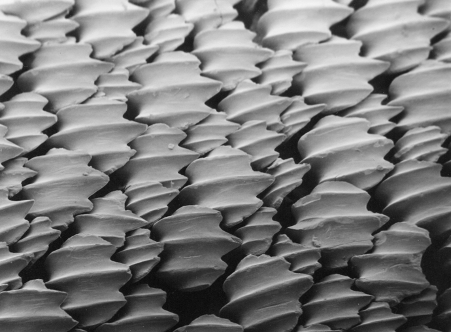
The simplest of course is to chase it down; a skill which the Mako Sharks have taken to the extreme. With a warm-blooded metabolism, streamlined body and powerful tail, the Shortfin Mako (Isurus oxyrinchus) can reach speeds of up to 60 km/h, allowing it to shoot through the blue and take its prey by surprise. This is aided by specialised skin, a feature which all sharks share. Though they look smooth, shark skin is covered in tiny, tooth-like structures called denticles. This specialised skin reduces drag across the shark’s body. It is such an effective streamlining adaptation, that it has inspired advances in aerodynamic engineering and athletic swimming apparel.
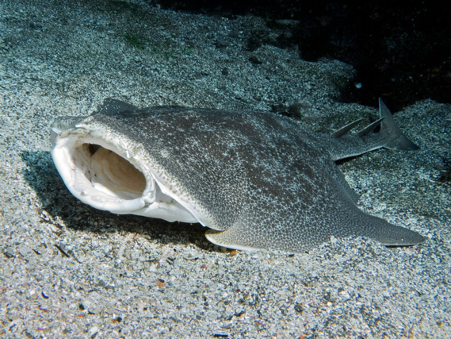
Other sharks take a more passive approach to feeding. Giant filter feeders such as the Whale Shark (Rhincodon typus) and the Basking Shark (Cetorhinus maximus) have tiny, ineffective teeth within their enormous mouths. By simply swimming forward, jaws agape, these gentle giants inhale clouds of tiny organisms such as plankton, krill and fish spawn.
Thresher Sharks (Alopiidae) wield exceptionally long, ribbon-like tail fins which they whip into shoals of fish to stun them and make for easy pickings. Various species of Angel Sharks (Squatinidae) and Wobbegongs (Orectolobidae) have flattened bodies with mottled colouring and frayed edges, providing camouflage which allows them to disappear into the seabed and lie in wait for unsuspecting prey to drift. It also provides cover from larger predators, but it cannot protect them from the highly specialised extrasensory abilities of other sharks.
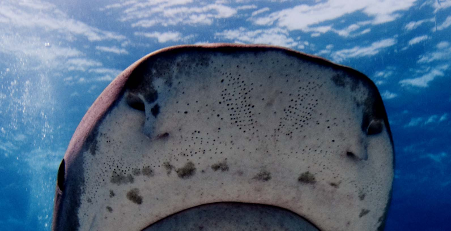
If you ever get within touching distance of a shark (which I have), you may notice what look like tiny black freckles peppering the skin around the shark’s snout. These are the Ampullae of Lorenzini, named for Italian ichthyologist Stefano Lorenzini who formally described these features.
The black spots are the openings of pores filled with a specialised mucus which are then connected to the shark’s nervous system. These receptors detect tiny changes in electrical charges in the surrounding water, such as those generated by muscle movement or nerve impulses. This electrosense has no equivalent in humans to make an easy comparison, but in essence a shark can ‘feel’ or ‘smell’ electrical impulses, allowing them to hone in on their prey even if they can’t see it.
This is taken to the extreme in sharks with greatly modified heads such as Hammerheads (Sphyrnidae) and Sawsharks (Pristiophoridae). The exaggerated surface of the head broadens the area that can be covered when hunting for prey hiding under the seabed; a tactic which both of these shark families are known to use.
Despite hundreds of millions of years of success, even in the face of mass extinction events, sharks now face an uncertain future. Hunting for their meat, particularly the profligate shark fin soup, leads to over 100 million sharks being killed every year. As apex predators, sharks serve an essential role in marine food webs by managing the populations of the species they eat. This maintains a balanced ecosystem, essential for creating healthy environmental conditions.
Unfortunately, sharks also suffer an unflattering and ill-deserved public image, thanks to various depictions as man eaters on the silver screen. In reality, annual fatal shark attacks on humans rarely enter double digits, which is fewer than snakes, dogs or even cattle. This makes it all the more important to convey to the public the plight of sharks, and what amazing and complex animals they are.
Further Reading
University Of Oxford - Greenland shark revealed to have longest life expectancy of all vertebrates
Leonard Compagno, Marc Dando & Sarah Fowler - Sharks Of The World