Lately, I’ve found myself pulled toward the creative edge of science—where language becomes a canvas and equations give way to emotion. There’s something quietly powerful in the fusion of art and astronomy, of data and feeling, of silence and story. And so, inspired by that convergence, I wrote something different. A piece that lives somewhere between the stars and the soul.
Let me tell you the story of the astronomer and the painter.
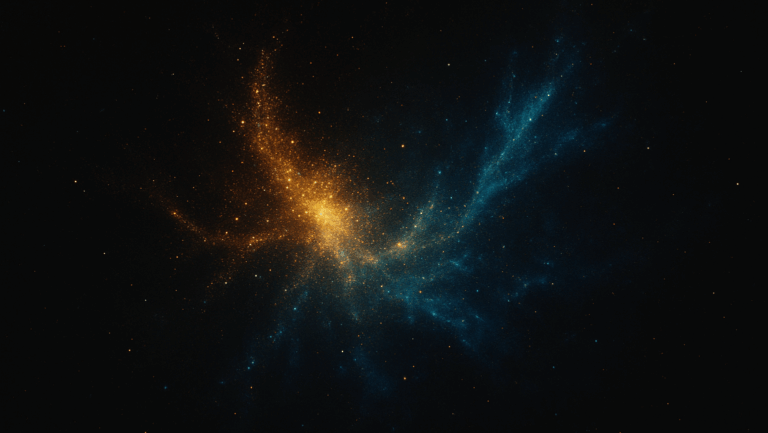
Across the black velvet canopy of the cosmos, pinpricks of starlight reach us from distances so vast they stretch both imagination and time. These are not just stars, but messages—echoes of a universe that remembers everything. They shine from a million years ago and yet find us now, in this moment, precisely when we are searching. We call it astronomy, this study of distant light, but it is also an act of faith. To look skyward is to believe that even the faintest flicker, long thought extinguished, might still guide the way.
There is an observatory nestled high in Tenerife, where each night begins in silence. An astronomer calibrates the lens of a massive reflecting telescope with the care of someone tracing memories across the sky. Across the ocean, in a quiet studio smelling faintly of linseed and lavender, a painter prepares her canvas. She does not paint what she sees. She paints what she feels—layers of colour drawn not from starscapes but from the contours of emotion, from joy and ache and memory. Her brushstrokes are spectral, like auroras cast in acrylic.
His name is unimportant. Likewise, her name is unimportant.
He captures data. She captures meaning. And in the quiet symmetry of their nights, a story unfolds.
Astronomy demands patience. Pulsars blink in measured rhythm, but their stories began in supernovae long before our species stood upright. Galaxies collide in dances that unfold over billions of years. Nebulae, those gossamer nurseries of stars, take a thousand lifetimes to become what they are. To be an astronomer is to be a witness to becoming. To learn that beauty is not always in the arrival, but in the persistence of the journey.
She paints in layers, the way the universe reveals itself—gradually, through contrast and texture. Her palette is cosmic: deep violets, hydrogen pinks, and ochres drawn from Martian dust. Her art does not mimic space. It converses with it.
Sometimes, it seems the world resists both logic and beauty. Grant funding collapses. Galleries remain indifferent. Satellites fail. Exhibitions fall through. The work goes unseen, the discoveries uncelebrated. And yet, they continue. He with the precision of star charts. She with the wild defiance of pigment. Because somewhere, they remember that the universe is on their side.
In a cold desert, a radio dish listens. Not for words, but for whispers—the low-frequency sighs of hydrogen atoms born shortly after the Big Bang. Through them, we trace the scaffolding of the universe, map the invisible, and find meaning in the static. This work is slow. It is uncertain. And it is unshakably worth it. Because sometimes, what begins as noise becomes signal, and what starts as longing becomes understanding.
And in a pale, window-lit studio, the painter confronts her own silence. Canvases line the wall, some untouched for months. Her days are tight—stolen moments, unfinished thoughts, the constant tick of borrowed time. Though her world is meant to be colourful, she often feels trapped in monochrome.
There are days when inspiration drips like a clogged faucet, and nights when the only light is the one she must kindle within. Yet still, she paints. Because somewhere in the texture of silence, in the ache of an unfinished thought, she hears the same frequency the radio dishes seek: something ancient, something honest, a truth not yet spoken. She too waits, she too deciphers, and from the murk of doubt, she too finds signal.
Some stars are gravitationally bound to each other forever. They orbit in silence, in tandem, never drifting too far. Others pass once, sling past, and never return—but the influence of that moment lingers in their trajectory forever. Astronomy shows us that connection can defy distance, that time does not erase significance, and that some encounters bend everything that follows.
Eventually, the painter and the astronomer stop drifting.
Their orbits align.
She teaches him how silence is not the absence of meaning but the space in which it gathers. That not all data arrives as numbers. Some arrive as breath. As stillness. As the kind of glance that makes time slip sideways. She shows him how emotion, though unmeasurable, shapes every truth we seek.
In return, he teaches her how structure can liberate. That within boundaries, creation can bloom. That the rules of the cosmos do not confine, they clarify—bringing form to feeling, shape to intuition, allowing expression to reach farther.
She teaches him how doubt is not weakness, but reverence—the willingness to hold uncertainty as gently as a star. That the unsolved carries its own form of beauty. That wonder doesn’t always need answers.
He teaches her how to stand unwavering behind what she knows to be true. That conviction isn’t noise—it’s clarity. That sometimes, to believe in something fully is to hold steady while the world peers in and questions. He teaches her that truth doesn’t always seek approval—it seeks resonance. That to be challenged is not to be wrong, and peer review is not the same as peer permission.
She shows him the texture of time—not in epochs or light-years, but in moments. The ones that pass between words. The ones that stretch across quiet glances. The ones that hum when two people understand one another without speaking.
He shows her that time, vast and unknowable, still answers to gravity. That even the oldest stars bend, and the faintest signals echo, and nothing meaningful ever really disappears.
Together, they do not compromise. They converge.
Between spectrometry and brushstroke, between algorithm and acrylic, they create something neither could alone—a new language, a fusion of stars and soul, capable of chasing starlight and telling its story in ways the universe itself might understand.
They are no longer merely observers of the cosmos. They are its translators.
Because even when the world stands in opposition, even when silence stretches for light-years and certainty flickers like a distant quasar, they have each other.
And behind them, the entire sky.
In the end, it is not about capturing light.
It is about becoming the force that holds it together—the gravity between stars, the resonance between notes, the brushstroke between galaxies.
It is about becoming the echo that never fades.
It is about chasing starlight, and finally understanding that starlight had always been chasing them too.