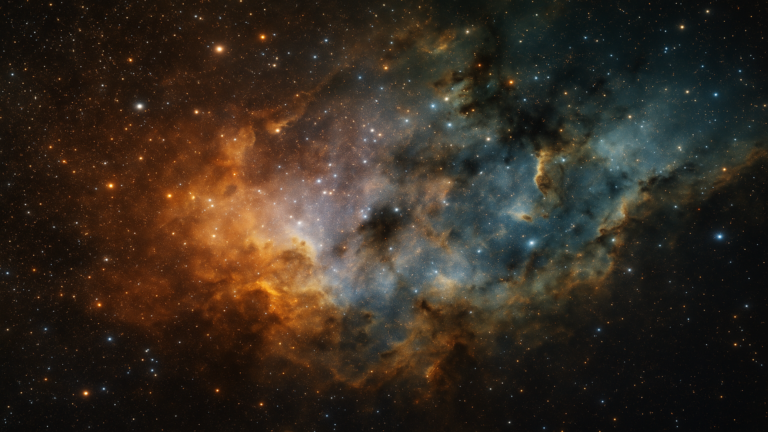
For those of you that don't know — stars are my thing. So today I'm writing a piece that delves into something I've been fascinated by for a long time: how rotation changes the life and chemistry of the biggest stars in the universe.
The Background
The assumption of spherical symmetry in stellar evolution breaks down significantly in the presence of rotation. Particularly in massive stars \(M \geq 8\ M_\odot\) rotation affects almost every aspect of structure and evolution: luminosity, effective temperature, convective boundaries, core mass, and even the final remnant type. The introduction of centrifugal support modifies hydrostatic balance, while non-uniform rotation \(\frac{d\Omega}{dr} \neq 0\) gives rise to a suite of transport phenomena not accounted for in classical 1D models.
Observational evidence strongly supports the need for rotation in stellar evolution models. Surface nitrogen enrichment in unevolved B stars, rapid rotators among Be stars, and core rotation rates inferred from asteroseismology all point to the presence of internal angular momentum transport and mixing. Therefore, a rigorous theoretical treatment is essential for interpreting high-mass stellar populations and their end states.
Angular Momentum Transport in Radiative Zones
Governing Equation for Angular Momentum Evolution
The evolution of angular momentum in a rotating, radiative shell can be described by an advection–diffusion equation:
\[ \frac{\partial}{\partial t}\left[r^2 \Omega\right] = \frac{1}{\rho r^2} \frac{\partial}{\partial r} \left( \rho r^4 \nu_\text{eff} \frac{\partial \Omega}{\partial r} \right) - \frac{1}{r^2} \frac{\partial}{\partial r}\left(r^2 \Omega U_r\right) \]
Here, \( \Omega(r,t) \) is the angular velocity, \( \nu_\text{eff} \) represents the total effective viscosity (from sources like shear and magnetic viscosity), and \( U_r \) is the radial velocity from meridional circulation. The first term denotes diffusive transport and the second term represents advective transport.
Meridional Circulation (Eddington–Sweet Flow)
Rotation distorts thermal equilibrium through the von Zeipel effect, driving circulation. The radial velocity of this large-scale flow is given by:
\[ U(r) = \frac{P}{\rho g C_P T} \left( \nabla_\text{ad} - \nabla + \frac{\phi}{\delta} \nabla_\mu \right) \frac{L}{M} f(\Omega) \]
In this context, \( \nabla_\text{ad} \) and \( \nabla \) are the adiabatic and actual temperature gradients, \( \nabla_\mu \) is the molecular weight gradient, \( \phi \) and \( \delta \) are thermodynamic derivatives, and \( f(\Omega) \) accounts for rotational geometry. This circulation redistributes both angular momentum and chemical species across the stellar interior.
Shear Instability and Richardson Criterion
Shear instability arises when differential rotation overcomes the stabilizing buoyancy. This is quantified using the Richardson number:
\[ \text{Ri} = \frac{N^2}{(\partial \Omega / \partial \ln r)^2} < \text{Ri}_\text{crit} \approx 0.25 \]
Where \( N^2 \) is the Brunt–Väisälä, a frequency, expressed as:
\[ N^2 = \frac{g \delta}{H_P} \left( \nabla_\text{ad} - \nabla + \frac{\phi}{\delta} \nabla_\mu \right) \]
When unstable, the resulting turbulent mixing has a diffusion coefficient:
\[ D_\text{shear} = \frac{K}{\phi + 1} \left( \frac{r \frac{d\Omega}{dr}}{N} \right)^2 \]
Shear mixing is especially relevant in early main-sequence evolution.
The Tayler–Spruit Dynamo
Even in radiative, non-convective zones, magnetic fields can be generated by differential rotation through the Tayler instability. This instability enables the generation of a dynamo loop. Differential rotation winds up a toroidal field \( B_\phi \), the Tayler instability destabilises \( B_\phi \) creating displacements, and reconnection events regenerate poloidal fields. The effective viscosity from this process is:
\[ \nu_\text{TS} \sim r^2 \Omega \left( \frac{\Omega}{N_\mu} \right)^{1/2} \]
This mechanism supports near solid-body rotation and is consistent with asteroseismic observations.
Observational Consequences of Rotational Mixing
Rapid rotators exhibit nitrogen and helium enhancements, and signs of CN-cycle processing through carbon depletion. These patterns align with predictions from Geneva models. Rotation also extends the main sequence lifetime by transporting fresh hydrogen to the core, keeping the star bluer and hotter. Rotating models show clear shifts on HR diagrams that match observations. Additionally, core–envelope decoupling inferred from Kepler red giant data suggests angular momentum must be redistributed more effectively than standard models predict. Tayler–Spruit transport helps address this.
Quasi-Homogeneous Evolution and GRB Formation
At initial velocities \( v_\text{ini} > 300\ \text{km/s} \), efficient internal mixing flattens \( \mu \)-gradients. The hydrogen envelope fails to expand, guiding the star down a Wolf–Rayet-like evolutionary track. If the timescale for internal mixing is shorter than the nuclear timescale:
\[ \tau_\text{mix} < \tau_\text{nuc} \]
Then collapsar-type long-duration GRBs may be possible, especially at low metallicity.
Computational and Theoretical Implications
Rotational physics is integrated into modern evolutionary codes like MESA, BPASS, and Geneva. These additions help explain blue stragglers, WR/O ratios, and nitrogen enrichment. TS dynamo models reproduce slow core rotation in subgiants. MESA predictions show extended MS lifetimes and enhanced WR yields at low Z. Transport coefficients such as \( \nu_\text{TS} \) can be empirically calibrated against asteroseismology and spectral types for better model constraints.
Final Thoughts
Rotation plays a defining role in shaping the lives and deaths of massive stars. From internal mixing to magnetic angular momentum redistribution, it’s clear that the assumption of spherical symmetry in stellar modeling is no longer tenable. As observational precision grows, particularly from missions like TESS and PLATO, our understanding of these processes will continue to evolve — and challenge — the boundaries of theory.
A Note on the Equations: How I Format Math in My Articles
A lot of people ask me how I format equations in my articles, and the answer is: I use a wonderful little plugin called MathJAX. Specifically, I’ve customised it using a method I call TASJax, where I use quadruple backslashes to ensure compatibility with WordPress:
Inline equations look like this: \( \Omega(r,t) \)
And display equations like this:
\[ \frac{dL}{dr} = 4 \pi r^2 \rho \epsilon \]
I always check that no line breaks or list formatting interfere with rendering. If you're a science communicator, educator, or blogger and want beautiful LaTeX-rendered equations inside WordPress — give TASJax a try.