This has to be one of the most asked questions of all time. How many of us can honestly say we understand why the sky is blue?
Why is a beautiful sunset red? What is a rainbow? What is that weird ring I can sometimes see around the moon when I look into a clear sky at night?
Read through this explainer to gain an understanding of reflection, refraction and scattering of light waves.
Understanding light
Let's start off by understanding precisely what light is. How would you explain it if challenged to do so?
I'll help. The scientific definition of visible light would be electromagnetic radiation with a wavelength between 380 and 750 nanometres, corresponding to frequencies between 750 and 420 terahertz between the infrared and ultraviolet. It's made of discreet packets of energy called photons.
A photon is essentially a particle of light.
So, light is made of particles? Well, not exactly. Since the development of quantum mechanics we've learned light is also a wave. We touched on that above when describing it's wavelength.
In an approximate way light is both a particle and a wave. In an exact representation it is actually neither.
It's something a little more complex.
Beans
Imagine looking at a can of beans, which we know is cylindrical. Hold it sideways and look straight at it and you'll see a rectangle. Spin it and look at the top and you'll see a circle.
So is it a rectangle or a circle?
Of course, it's neither. It's cylindrical. What we learn from this is we can't fully describe a 3 dimensional object using 2 dimensional terms. Light is a lot like this.
When we look at the sides of the bean can we are seeing what is essentially a shadow. A shadow is a 2 dimensional collapsed version of a 3 dimensional object.
When we look at a quantum particle such as a photon, what we are seeing is a collapsed version of something more complex, a wave. But equally to describe light as 'only a wave' is treating it as a much simpler object than it truly is.
Okay, so WHAT is light?
We know it's complex that's for sure! Here is how I would describe light as accurately as I can.
Light is a complex-valued probability distribution that has quantized (discrete) properties such as energy. The smallest piece of light is called a photon.
Like a wave, a photon experiences diffraction (bending around corners), interference (fringed patterns), refraction (bending when entering a material), reflection, dispersion (wave-shape spreading), coherence (lining up of phases), and has a frequency.
Like a particle, a photon contains a fixed energy, a fixed momentum, a fixed spin, and can be measured to have a single fixed location in space. The wave-like and particle-like traits of a photon trade off according to the Heisenberg Uncertainty Principle. This means that the more you force a photon to act like a particle, for instance by confining it in a small box thereby lowering the uncertainty in its position, the less it acts like a wave.
Welcome to the crazy world of quantum mechanics.
Blue sky thinking and rainbows
So what on earth does this have to do with why the sky looks blue? The answer is this instance is to peer into the wave like properties of light a little deeper and wrap our heads around the colours of the rainbow.
Let's first understand a rainbow, trust me it will help.
Rainbows are made up of lots of brilliant colours and that is white light split up into it's differing wavelengths by droplets of water.
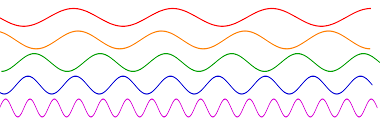
Light enters the water droplets and is refracted, then reflected off the back of the droplet, like a mini lens. As the reflected light leaves the droplet it is refracted again at multiple angles dependant on it's wavelength. As you can see from the image above, each colour has a slightly different wavelength and that is how the colours are split apart. Reds and oranges have longer wavelengths than purples and blues.
The result is that you as the observer see a beautiful arc of colours. It forms an arc because we can only see the light waves affected above the horizon.
Rare is beautiful
I think one of the most incredible sights to see is a fully circular rainbow. As described above, we can only usually see an arc because of the horizon line of the Earth. All rainbows are circular though, from one vantage point at least. You may even see a double rainbow, which is made of a bright primary rainbow and then a slightly dimmer secondary rainbow above it.
Pilots will sometimes be lucky enough to see a circular rainbow if they are in the correct position.
The rest of here on Earth are stuck with our arc rainbows, unless we look into the black sky of a clear night with a bright moon.
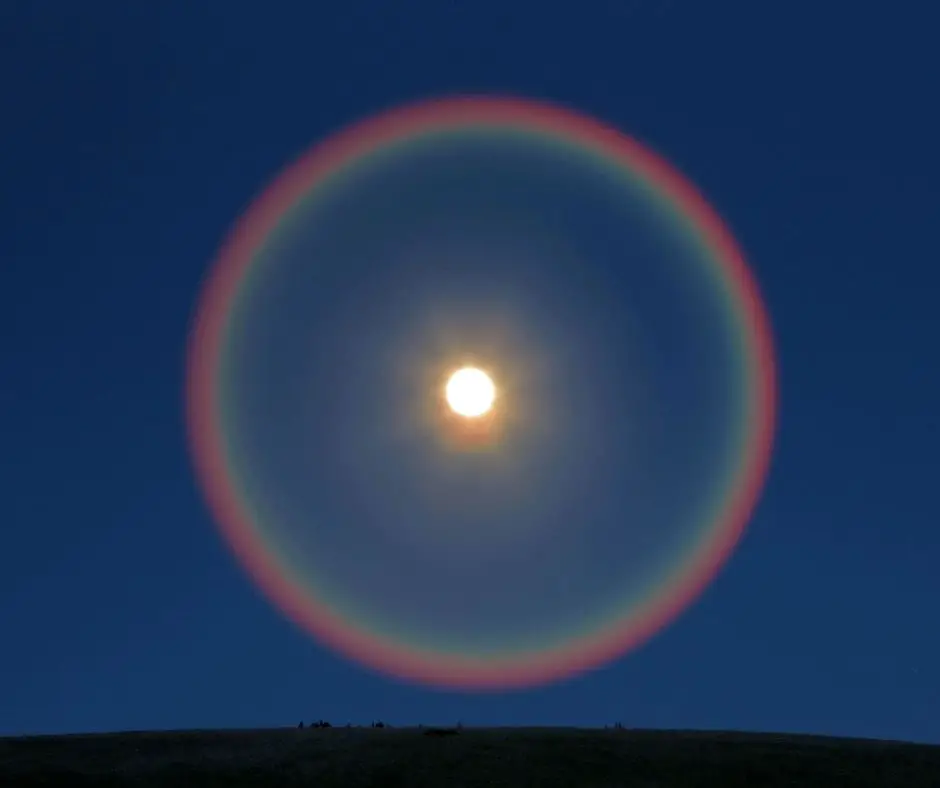
Under the right conditions, with a little moisture in the air which is quite common at night we can sometimes catch a glimpse of a strange 'ring' around the moon. You may have seen it before and wondered what it was.
It's light from the sun, reflected off the moon, entering water droplets and refracting and reflecting again to split light into its individual wavelengths. A dim moon will give a white haze around it but a bright or full moon will reveal the colours. As it's well above the horizon line you'll be able to see the full circle and not just an arc.
This beautiful phenomena is a lunar rainbow, more often called a Moonbow.
Why the sky is blue if space is black?
Space is black because light travels through it in straight lines. There is nothing to bend, reflect, refract or scatter it.*
When light reaches the atmosphere of the Earth it is scattered in all directions by the gases and particles that make up the atmosphere and because the blue wavelength of light is shorter and travels in smaller waves it is scattered much more and that is why we see more of it.
If you look to the horizon on a bright sunny day then you're peering through a bigger 'wedge' of atmosphere. The rays of light you see will have been scattered and re-scattered many times, plus reflected back from the Earth. The effect is that you'll see lighter blue and perhaps even pretty close to white.
The sky is always at its most blue directly overhead.
Red sky at night, shepherds delight
As sunset draws closer the sun lowers toward the horizon line and light has to physically pass through more of the atmosphere to reach you. A greater percentage of the blue light is scattered allowing red and yellow wavelengths pass through to your eyes, creating those beautiful crimson colours.
So why is the sky blue, why are sunsets red and rainbows arced? Because light is a quantum probability distribution displaying the properties of both waves which can be bent and scattered and particles which can be absorbed by our eyes.
Differing wavelengths and conditions mean varying 'parts' of light are eventually observed, but it all depends on your vantage point and what might be between you and the light source.
So, if your child comes home from school with a picture they have drawn and they decided to make the sky green or purple, don't correct them.
The sky is all the colours of the rainbow at once, we just can't usually see it.
*I've inserted a caveat into this statement because gravity bends light and you can find out more about that in my piece on gravitational lensing. In this instance I'm referring to an absence of materials similar to those found in the atmosphere of the Earth rather than definitively 'nothing'.