



To summarise in a single sentence, gravitational lensing is the observable effect of photons of light travelling in straight lines through curved spacetime and producing multiple or distorted images to a distant observer.
It sounds very complex, but with a little explanation we should be able to understand it, so let's try.
3D or 4D?
First we need to understand a little about dimensions. Most of us will be familiar with the term 3D. We understand that the world we live in is 3D and we can create cool 3D computer images and not so cool nauseating 3D movies.
Actually though, that's not quite right. 3D is enough for computer images or movies but the world we live in is 4D.
The 3 dimensions we are so familiar with are length, width and height. They are what we would call dimensions of space. They tell us about physical attributes and locations. We are living with a 4th dimension though and that is time.
This can easily be understood by thinking about something as simple as attending a meeting in a high rise building.
Please meet me at 120 High St, I'm on floor 5. There are our 3 dimensions of space and we should have enough information to get to our meeting now. We can't though, because there is something missing and we have to ask another question.
That question would be 'when'?
In order to attend the meeting we must know the 3 dimensions of space and also the 4th dimension of time.
Einstein
Famous for many ground breaking theories Albert Einstein believed that space and time weren't mutually exclusive. They were in fact, so intrinsically connected they were one and the same. He called this idea spacetime.
You may have heard of this famous piece of work, written in 1915, it was called 'The General Theory of Relativity'. I'll cover that in more detail in another post.
Gravity
The general theory of relativity teaches us many things about our universe and one of the key facts is that spacetime itself is not flat, it can be bent and warped.
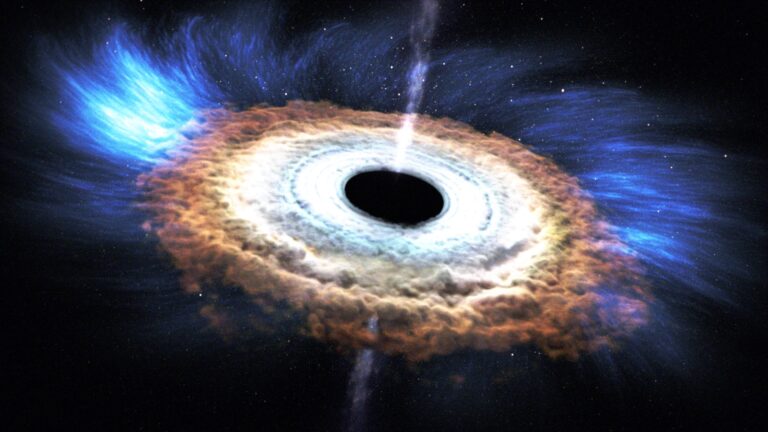
In order to bend spacetime you need something heavy. Really heavy. Everything bends it a little bit, even you and I, but to notice the effect you need to put something really massive in it, like a planet.
Imagine the earth as a bowling ball. Now imagine putting that bowling ball onto a tightly stretched blanket. It's going to create a depression in that blanket around it. It's going to warp and bend the surface of that blanket.
Now imagine rolling a marble towards the bowling ball in a straight line. What is going to happen when it reaches the part of the blanket warped by the bowling ball? It's going to start following the curve of the warped blanket right?
Absolutely right and this is precisely what's happening with planets and moons. Planets warp the spacetime around them and moons simply travel in straight lines around the curved spacetime.

The Sun is even more massive. It creates a huge warp in spacetime so large in fact that everything in our solar system moves in straight lines through the curved spacetime around it. whilst also creating their own curves to keep other smaller objects moving around them.
Hills and valleys
This paints a picture of of bends and curves everywhere in the universe and it turns out that despite not being able to see this for himself, Einstein was unsurprisingly correct.
A famous phrase was coined from this and its well used in Sci-fi and science documentaries alike. 'The fabric of space and time'. We've all heard that one I'm sure!
The effect of being pulled towards the middle of something heavy, curving spacetime is what we feel as gravity. The more massive the object, the more it warps spacetime and the stronger the effect of gravity feels.
This is why astronauts on the moon walk in that strange bouncing way and seem to float a little. The moon is much smaller than the earth. It warps spacetime less and therefore the effect or strength of gravity is less.
Cosmic sized lenses
When we look at objects in the universe a very long way away what we are actually seeing are photons, or particles of light. They must travel the distance between the object and our eyes (or telescopes) in order for us to see them. Photons are particles and they too must navigate the perilously curved spacetime to reach us.
They travel in straight lines, but the path they take is curved and warped by the massive objects in it.
If we put a really massive object in the way, like an entire galaxy for example imagine the size of the curve in spacetime that would make. It would be unthinkably huge. As photons try to travel in a straight line to our eyes they bend around these huge curves. When they converge again on the other side, sometimes they don't perfectly line up. Its this tiny misalignment that distorts our image of that object and that is a gravitational lens.
Its so remarkable in its effect we are sometimes able to see objects that are 'hidden' behind other galaxies simply because the light they emit bends so strongly around the curved spacetime.

I think its mind blowing that Einstein was able to visualise this incredibly elegant feature of our universe and now, so can you.