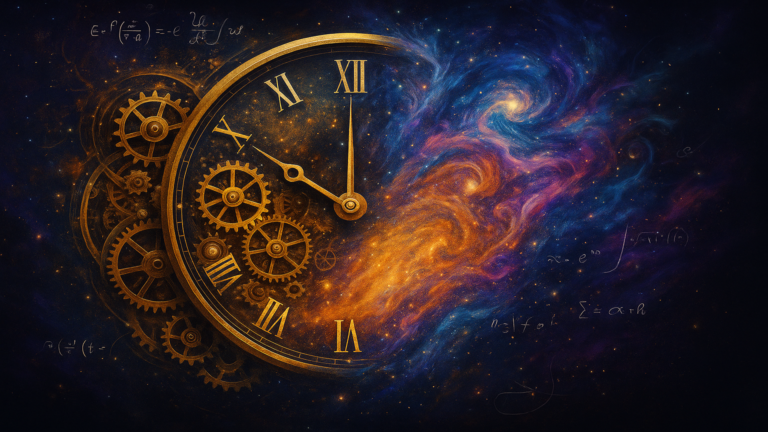
Somewhere beyond the veil of sight, beyond the reach of our most sensitive telescopes, beyond the whisper of background radiation that bathes all creation—there exists a library.
Not a library made of stone or steel, but one written into the fabric of spacetime itself.
A library of lost things.
It does not have shelves or catalogues, nor a librarian to guide the hand. And yet, it holds everything that ever was: every collapsed star, every vanished world, every light that flickered and faded long before Earth knew breath.
We live in a universe that remembers—but only in the quiet language of gravity, entropy, and decay.
The Forgotten Stars
Once, great blue stars spun at breakneck speed, burning through their nuclear lifetimes in mere millions of years—cosmic fireworks, gone before the ink on the cosmic calendar had dried.
They lived hard and died spectacularly, in supernovae that laced the interstellar medium with gold, iron, calcium—echoes that now live in our blood, our bones, our wedding rings.
But the stars themselves? Gone.
Their light scattered across the dark. Their presence remembered only in gravitational wakes, neutron hearts, and the enrichment of everything that came after.
They are the first books in the Library.
And they were never meant to last.
In the silence that follows their collapse, there is an elegy. One sung not in words, but in bent space, in magnetism, in X-ray pulses ticking out the final verses of stars that once ruled the skies. To gaze upon a pulsar is to read the margins of a chapter that ended long ago.
Lost Planets, Silent Moons
For every exoplanet we find, a thousand more remain uncharted.
How many Earths were shattered by asteroid strikes, swallowed by their stars, or flung into interstellar darkness? How many once hosted oceans, winds, weather, even life—now silent, buried beneath radiation, or frozen beneath forgotten skies?
There may be a world somewhere, once rich with life, now orbiting nothing. A planet without a sun. A library of its own, adrift.
And we will never know its name.
Somewhere in a dying system, a tide may still rise and fall against a barren shore. No eyes to witness it. No voice to tell the tale. But the rhythm remains. The memory of motion. The ghost of a moon’s embrace.
Cosmic Amnesia
Even light—the fastest, most tireless of messengers—cannot outrun time forever.
Look far enough, and we stare into an ancient fog: the cosmic microwave background, the earliest readable page of the universe.
Before that?
A blank.
The Library of Lost Things is not simply a collection of cosmic debris—it is a vast archive of everything the universe cannot retrieve.
Information falls into black holes, scattered across event horizons. Stars collapse into silence. Particles decay into anonymity.
Time, ever moving forward, is not a gentle librarian.
It erases more than it preserves.
Some say information is never truly lost—that in the weave of quantum fields, the universe still keeps perfect accounts. If so, then every atom you've ever touched, every thought, every goodbye, is encoded still in some unreachable script, filed neatly in a catalogue we cannot read.
A Chapter on Us
One day, the Earth will be a forgotten footnote.
The Sun will expand, swallow Mercury and Venus, and scour the solar system with heat. Even if we survive—spread across planets, stars, galaxies—entropy waits for everything.
The atoms in our bodies will return to dust.
The records will fade. The servers will fail.
But before that:
We build.
We remember.
We reach.
Voyager sails still, carrying greetings in 55 languages and the sound of a baby’s cry.
We launch telescopes to see the dawn of time.
We write, we film, we sing.
We place our memories into satellites, into silicon, into the minds of children.
We rage against the dark by sharing our stories.
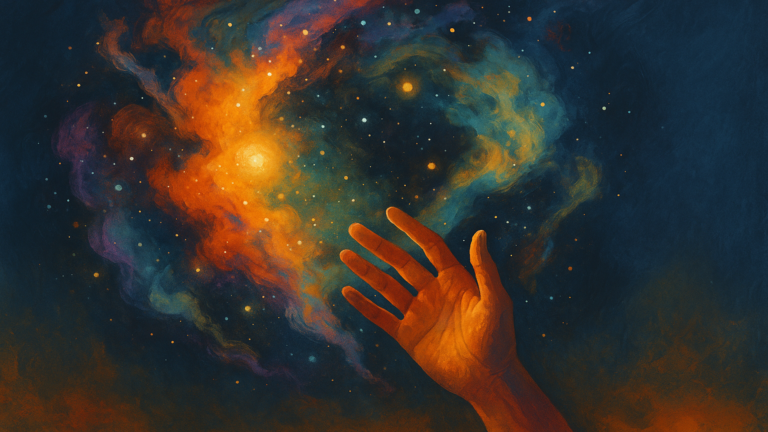
Our fingerprints are faint, but deliberate. A handprint in the dust. A radio signal in the void. A lullaby sung to a distant planet we will never touch.
The Wonder of the Lost
And so the Library of Lost Things is not a tragedy. It is a reminder.
That nothing, no matter how brilliant, is permanent.
That to exist, even for a moment, is a kind of miracle.
That every fading star, every long-extinct species, every old woman’s laugh that no one recorded… mattered.
In the end, the Library teaches us the most human lesson of all:
To love what is now,
to remember what was,
and to honour the vanished things,
not by mourning their loss,
but by marvelling that they ever were.
We walk through a universe that forgets, and yet we choose to remember.
We name the stars. We give purpose to the patterns. We write our stories in sand, knowing the tide will come, yet we write them anyway.
For in this fragile act of remembrance lies the truest kind of hope.
A flame passed hand to hand, even as the wind rises.
A library that cannot be shelved, only lived.
A place where nothing is truly gone, only treasured differently.
A place we return to, again and again.
The Library of Lost Things.