Chapter 1 - Cells as Cities
Every biology student—or honestly, anyone who has ever opened a science textbook—has read "all living things are made up of cells." Sounds boring, right? You might ask: what even is a cell? Is it a battery? A container? Perhaps it's like the little jail cells inside every living body (spooky much)?
What if I told you that cells are actually bustling, dynamic cities? And don't worry—I have amazing evidence to back it up.

City Boundary: The Membranes and Walls
Let's imagine we're entering a city. Before all the glitz and glamour, there are protective walls surrounding it. There may be gates, barriers, and most importantly, guards (think of them as burly men with huge mustaches). Just like every city has a basic protection layer, our cells also need protection.
From what, you might ask? I mean, there aren't exactly thieves and troublemakers in cells, right? Well, it turns out there are—bacteria, viruses, toxic chemicals, you name it—all determined to harm our cells. So cells have protective walls around them called cell membranes (6). Plants and microorganisms are even more sensitive and have an extra layer of protection called a cell wall.
And like every good protective barrier, there are guard proteins that check the IDs of every chemical trying to enter. If they determine something is harmless, they allow it through. If they detect suspicious activity, they block entry. This process is called selective permeabilization—the controlled entry of selected substances into the cell. Think of it like a bouncer keeping underage kids out of a club.
Infrastructure and City Hall: What is Cytoskeleton and Nucleus?
Now that we're inside the cell, we need roads, bridges, and underpasses to take us wherever we need to go. The cell in our body is tiny, but it's also properly organized. These passages inside our cellular city are called the cytoskeleton. Like the skeleton in the human body, the cytoskeleton provides the foundation for our city and gives it clear structure.
Furthermore, if you venture deeper into the city, the first thing you'll likely see is a tall, imposing building in the center—the city hall. Just as a city hall organizes and plans for the entire city, the city hall in our cells gives instructions on what needs to be done. The only difference is that the city hall of cells is called the nucleus(3), which controls all activities within the cell.
Mitochondria is the Powerhouse of Cell:
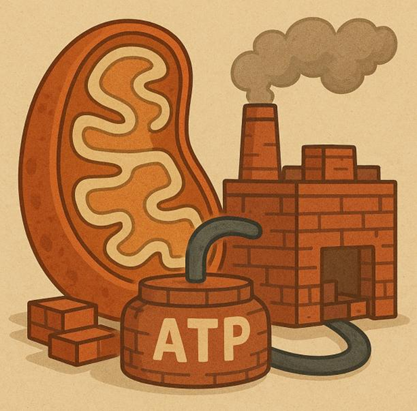
Proceeding with the tour of our cell city express, the next thing that makes it a true city is a powerhouse. The mitochondria is the powerhouse of the cell.
Let's break it down. Just as a city needs a powerhouse to generate electricity and gas for its residents, our cells need mitochondria to produce energy for cellular functions. Cells don't need electricity, but they do need power—and they get it not in watts, but in the form of ATP, also known as adenosine triphosphate(1). This ATP is the energy currency of the cell, and all cellular processes need energy from ATP to work.
Plants, unlike human and animal cells, make their own food and therefore need an additional power production facility called a chloroplast. This extra powerhouse helps plants produce food by capturing sunlight.
So far we have security, city hall, infrastructure, and powerhouses in our cell cities. But as someone once said: just as pizza is incomplete without a cold drink, a city is incomplete without its people. (I said it!)
Bricks and Brick Factories: How Proteins are Made?

Cities are made up of houses, houses are made up of bricks, and bricks are made up of—wait, I forgot. But what matters is that houses and every other building in a city are made up of bricks. In our cellular city, these bricks are proteins(2), but unlike real bricks, these proteins must be made in a specific order.
In Cell City, its city hall—the nucleus—has all the information needed to make them in the correct order. But who makes these bricks? The answer is simple—the brick factory does. These brick factories are called the endoplasmic reticulum (or ER, as we call it). There are two types: the rough ER makes the bricks (proteins), while the smooth ER handles transport.
No factory works without workers — the actual workers who make our proteins are called ribosomes. These ribosomes make proteins in the rough ER and transport them to the packaging facility, the cell's Golgi apparatus(5) via the smooth ER. The only function of the Golgi is to pack and transport these bricks, or proteins.
Municipal Committee: Lysosomes and Their Role
Before I dive into why I'm explaining all this stuff and become an even bigger nerd, let me explain the anti-pollution activities in our cellular cities (my Asian mom would be proud). Not only is our cellular city organized, it also has a municipal committee whose only job is to keep our city clean and safe from hazards. This municipal committee is called lysosomes, which keep our cell clean and maintain its integrity. They do this by engulfing - aka eating - the cellular waste and transporting it out of the cell. (Talk about sacrifice.)
Now that we've toured our cell, allow me to get nerdier and talk about a big concept called systems biology.
United they Stand, Divided the Fall: Systems Biology

Let me ask you this for a moment: do the components of a city work independently (like rebels) or do they work together for a perfect, balanced, harmonious structure? Well, we all know the answer. United they stand, divided they fall. Likewise, if the individual components of our cities start working on their own, even the most well-built cities will collapse.
The same applies to our cellular cities. They cannot work alone. The nucleus, Golgi, ER, cell membranes - everything needs to work together in perfect harmony to keep us living. And that, my friends, is Systems Biology(8). Not the cellular city as individual components, but as a living, breathing unit working together.
The Continuity of the Story: Biotechnology
But WAIT! The story doesn't end here.
What if you want the city hall to make different brick types because that's what you need now and the city's preferences have changed? What if you want to change the packaging style of these bricks to make the city run more smoothly? These what-ifs are where I and people like me (nerdy scientists) come in. This is where I tell you about something very cool called biotechnology(7).
Don't be afraid of this big word. It's essentially changing the cellular city structures so not only does the city work, but it also works efficiently and does what we want. How does biotechnology do it? Well, that's a different story for a different day, but know that the world of possibilities is endless and I'm excited to explore it with you.
So the next time someone seems confused about biotechnology, you can first confidently explain that cells are like cities—complex, organized systems that we can study and improve. Until next time.
ADDITIONAL RESOURCES:
- Khan Academy. (n.d.). ATP: Adenosine triphosphate. https://www.khanacademy.org/science/biology/energy-and-enzymes/atp-reaction/a/atp-definition
- MedlinePlus Genetics. (n.d.). What are proteins and what do they do? U.S. National Library of Medicine. https://medlineplus.gov/genetics/understanding/howgeneswork/protein/
- Arizona State University, Ask A Biologist.(n.d.). Nucleus. https://askabiologist.asu.edu/cell/nucleus
- Arizona State University, Ask A Biologist. (n.d.). Building blocks of life: Protein factories. https://askabiologist.asu.edu/explore/building-blocks-life
- Lodish, H., Berk, A., Zipursky, S. L., et al. (2002). The Golgi apparatus. In Molecular Cell Biology (4th ed.). W. H. Freeman. Retrieved from https://www.sciencedirect.com/science/article/abs/pii/S1470817501000236?via%3Dihub
- University of Utah, Learn Genetics. (n.d.). Cell membranes. https://learn.genetics.utah.edu/content/cells/membranes/
- National Institute of Biomedical Imaging and Bioengineering. (n.d.). Biotechnology. National Institutes of Health. https://www.nibib.nih.gov/science-education/science-topics/biotechnology
- European Bioinformatics Institute (EMBL-EBI). (n.d.). What is systems biology? https://www.ebi.ac.uk/training/online/courses/systems-biology/what-is-systems-biology/
- All images are AI-generated.