Gene Editing, CRISPR, and Dr. Overworked Pastry's Quest for Non-Freezing Tomatoes
- CRISPR Origins: Discovered as a bacterial defense system that stores viral DNA "memories" to fight future attacks, later adapted for precise gene editing.
- Gene Editing Tool: Scientists use guide RNA to direct CRISPR-Cas9 molecular scissors to cut specific DNA sequences with remarkable precision.
- Limitations: Despite effectiveness, CRISPR faces off-target effects, delivery challenges, and ethical concerns around designer babies and bioweapons.
The Fish Tomato Fiasco
Dr. Overworked Pastry - OP for short - does NOT like frozen tomatoes.
But such is his luck that he lives in the Arctic.
Now desperate for warm tomatoes and bored out of his mind, he comes across something that makes him forget about the tomato sauce he should currently be making: an article about something called a Fish Tomato (1).
He laughs it off at first, but when he reads it (out of pure curiosity), he realizes that his dream of forever warm tomatoes is not just his imagination. It is a reality.
He discovers that his friends (who also love tomatoes) had created a new type. But this was not just any ordinary tomato, it had genes from a fish. And not just any gene (recall genes from our chapter 1), but the gene that gives the Flounder Fish its antifreeze property. This new tomato was resistant to freezing temperatures (2), but it had a catch. It was never commercialized due to consumer backlash! While the idea was brilliant, people were skeptical about fish genes living in their tomatoes. OP was disheartened, but he's a biotechnologist, and times have changed, so he might just have a chance at his fairytale tomatoes.
After another tomato soup failure later, OP had had enough. He decided to address public concerns and help his own case. So, he thought: instead of taking antifreeze genes from a fish, why not modify the tomato's own genes? 30 years ago that might have sounded impossible, but now he had a tool, a much more precise and effective tool to enhance the effect of one gene or silence it.
And that tool was called CRISPR-Cas 9.
He used that tool to knock out the tomatoe's genes that gave it the freezing vulnerability and lived happily ever after with his warm tomatoes.
(To clarify, the actual CRISPR-edited tomatoes have not been made yet, but the part about Fish Tomatoes does exist and was developed in the1990s.)
CRISPR: The Origins
Like most things in science, CRISPR (Clustered Regularly Interspaced Short Palindromic Repeats) was discovered by accident. The Japanese scientist Yoshizumi Ishino, along with his team, was sequencing a gene in E. coli (a bacteriam) when they found some sequences of repeats in its genome (recall from chapter 2).
Later, it was discovered that bacteria are generous hosts but also vengeful protectors. This means whenever a virus (the bacterium's enemy in this case) attacked it, the bacterium killed that intruder and saved this victory in the form of short repeating sequences as a memorial (3). This system not only helped bacteria boast to other bacteria (I'm joking!), but most importantly, they served as a memory system. This way, when the same virus attacks again, the bacterial system can essentially say, "Oh! We've seen this one before and killed it once, so we can definitely do it twice!" This formed an incredibly sophisticated bacterial defense system, but little did these tiny organisms know, they were unknowingly developing what would become one of humanity's most powerful tools (as always, it was always about us).
CRISPR-Cas9: Nature's Molecular Scissors
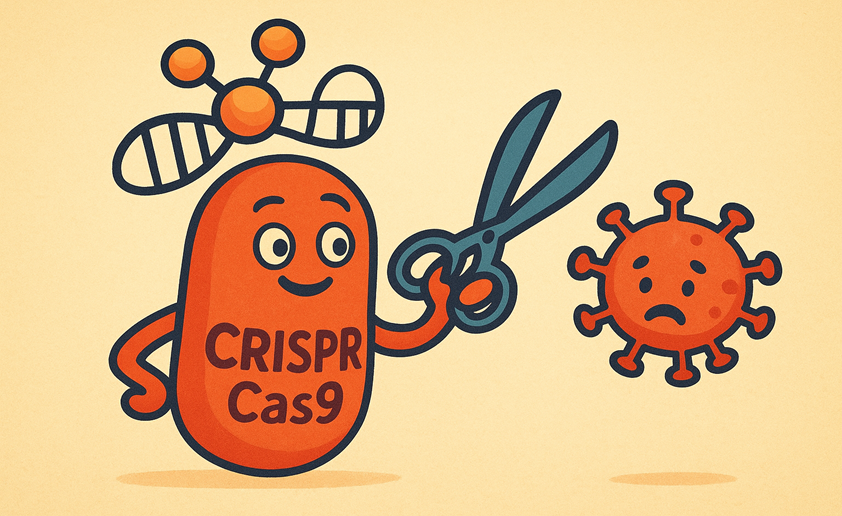
After humans discovered that such a defense system exists, they started studying it intensively. What they found was that CRISPR is not alone. CRISPR has a sidekick. This sidekick was called Cas proteins that helped slice the virus' DNA.
But here's where it gets interesting for us. In 2012, two outstanding women (Jennifer Doudna and Emmanuelle Charpentier) discovered that this CRISPR-Cas 9 system not only slices viral DNA - it can target any DNA sequence we want if we just create one small thing: a guide RNA, or gRNA for short.
This gRNA must match the sequence of the gene we want to cut. Then it grabs Cas-9's hand and guides it to that exact DNA sequence we want to target, and then Cas 9, with its brilliant slicing technology, cleaves this DNA. Now, our DNA is a magnificent thing because it can repair itself. DNA after being cut chooses one of two repair pathways available to heal itself (4). It can either use NHEJ (non-homologous end joining), which is quicker and used for small deletions or insertions, or it can employ HDR (homology-directed repair), which is a more precise method. Even better, we can influence which repair mechanism occurs just by providing a targeted repair template DNA. Clean, effective, and smart, right? But wait! There's a catch because there's always a catch -- especially when we're messing with nature.
The Reality Check: CRISPR's Limitations
While OP loves science, he also understands the limitations that come with tinkering with nature. For instance, CRISPR, though it is the most effective genome editing method available, still may have some unintended consequences. It may, for instance, not make cuts precisely at the place where we want to edit the genome and instead slice it at a completely different location. And we all know what happens when something occurs that shouldn't happen—we suffer from side effects we never intended. This process is known as off-target effects, and they can be very harmful in some cases.
Beyond off-target effects, just getting the CRISPR-Cas-9 system to our desired location in the body is a major challenge. In humans, it's even more difficult because we cannot simply employ viruses or bacteria as delivery systems the way we do in laboratory settings. Another limitation CRISPR faces is that it's best suited to small edits and knocking out genes, but for larger genes or whole genomes, we encounter significant problems.
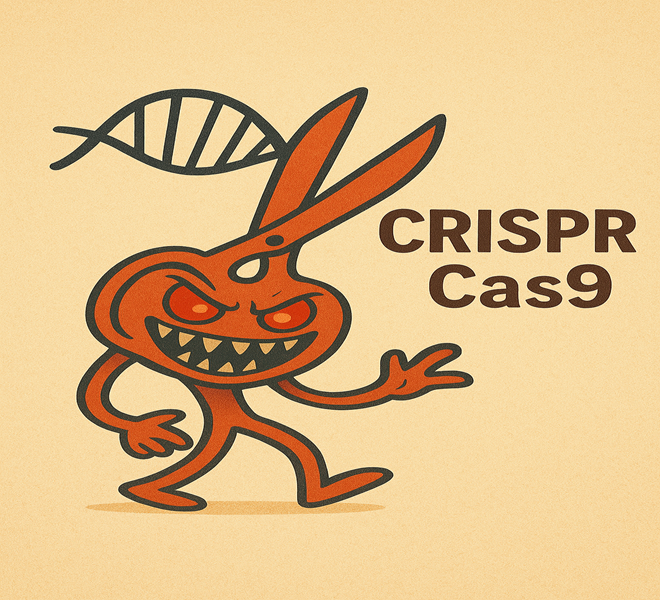
If OP were to write about all the limitations and disadvantages of CRISPR, he would say that ethical concerns override all technical limitations in many cases (5). The possibility of designer babies, bioweapons, human cloning, and hybrids are some of the scenarios in which biotechnology must yield to ethics. Understanding that previously unimaginable things could now become reality, like creating a whole new life on Mars, biotechnology and CRISPR ultimately surrender to the strongest force of life - nature itself. But more on that another time.
CRISPR: Is It The End?
Despite his passion for warm tomatoes, OP eventually realized that in practical biotechnology, there would always be many hurdles. Even if he overcame every obstacle in the lab, ethics and human nature would not allow his wild imagination to run unchecked. But all is not lost — not for OP and definitely not for us.
As his mind began to wander beyond the limitations of the lab, he discovered something far cooler. What if his wildest scientific dreams could be explored not in the lab, but virtually, on a computer? So, this is the beginning of how OP discovered bioinformatics and the dry lab. But more on that adventure in the next chapter. For now, OP would love to enjoy his perfectly heated tomato soup.