- Parkinson's may start in the gut - Constipation appears 20 years before motor symptoms in 24.5% of cases, suggesting the disease originates in the digestive system, not the brain.
- Gut bacteria spread toxic proteins - Harmful alpha-synuclein aggregates travel from gut to brain via the vagus nerve, with certain bacteria like E. coli accelerating this deadly process.
- New gut-based treatments emerging - Ketogenic diets, fecal transplants, and probiotics show promise, though most remain experimental and need optimization.
“Constipation precedes the official diagnosis by two decades, leading scientists to look at the gut."
Research into the Parkinson's disease gut connection is revolutionizing our understanding of this neurodegenerative condition. Dr. C, a professor living with Parkinson’s since 2014, experienced firsthand how this Parkinson's disease gut relationship disupted one of life’s most basic functions: “I had a routine [emptying the bowels] — until Parkinson’s disease came along. Now, I don’t sense ‘having to go’ in the same way. Days will go by without a visit to the white throne. Things get backed up worse than the Los Angeles freeway at rush hour, which gets quite uncomfortable.”
The Gut-Brain Connection
While Parkinson’s disease is usually marked by the loss of neurons in the substantia nigra that affects motor functions, Dr. C’s bowel issues highlight its less obvious aspects. An astonishing 80-90% of advanced Parkinson’s patients experience severe constipation. Interestingly, in 24.5% of cases, constipation develops two decades before motor symptoms, suggesting that Parkinson’s disease might originate in the gut rather than the brain.
Since most Parkinson’s cases are influenced by environmental factors (such as head trauma, chemical exposure, and poor diet), researchers are now focusing on a key element affecting gut health: the gut microbiome. This microbial ecosystem, with a genetic code 150 times larger than our own, typically plays a crucial role in maintaining gut barrier integrity and overall health. However, when disrupted by stress, antibiotics, or an unhealthy diet, its effects on our health can range from bloating to serious conditions like cancer, metabolic diseases, and neurodegenerative disorders.
Groundbreaking Research
This gut-brain connection prompted Dr. Tim Sampson, then a postdoctoral researcher in our lab (now an assistant professor at the Emory School of Medicine), to ask: Could gut microbes directly modulate Parkinson’s pathology?
To find out, he transplanted stool samples from Parkinson’s patients or healthy individuals into a mouse model of Parkinson’s disease, effectively giving them human gut microbiomes. The result was fascinating: mice transplanted with Parkinson’s microbiomes developed far worse motor impairments compared to those receiving healthy donors’ microbiomes, providing the first experimental evidence that gut bacteria may actively drive neurodegeneration.
A team led by Dr. Haydeh Payami, a professor at the University of Alabama at Birmingham, took it a step further. Using DNA sequencing data from stool samples (to analyze the microbial communities in the gut), they examined the different microbial profiles in Parkinson’s patients and healthy individuals. The result strengthened Sampson’s mouse experiment; the patients’ microbial profiles differed from those of healthy individuals, suggesting that an imbalanced gut microbiome may drive the disease.
These preliminary findings suggest that Parkinson’s disease may originate in the gut, and the gut microbiome plays a crucial role in modulating its progression. But the question remains: How does the gut microbiome drive Parkinson’s disease?
The Spread of Toxicity from the Gut to the Brain
While Parkinson’s symptoms differ among patients, over 90% of cases share a key feature: the buildup of misfolded alpha-synuclein protein aggregates in neurons (Figure 1). Normal alpha-synuclein protein serves a specific function in the brain. However, in Parkinson’s patients, this protein misfolds or clumps—forming aggregates—and spreads through the body by inducing normal alpha-synuclein proteins to clump together.
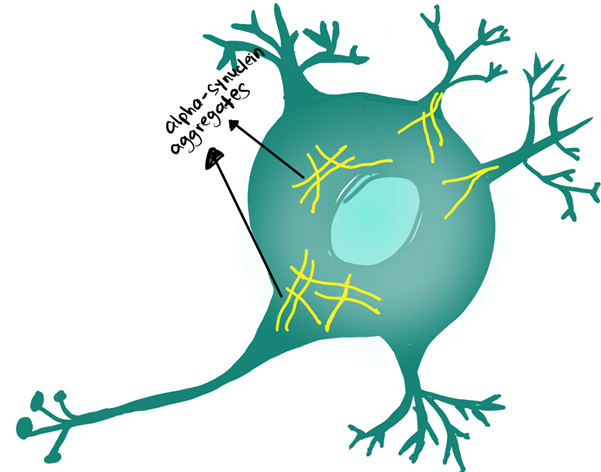
In 2003, German neuroanatomist Heiko Braak found these aggregates appeared first in the enteric nervous system—the gut’s independent network of neurons—before appearing in the brain. As it turns out, alpha-synuclein aggregates damage the neurons responsible for bowel movements, which causes constipation. These aggregates initiate their attack in the gut, explaining why constipation occurs decades before it reaches the brain and affects motor functions.
The Pathway of Destruction
Through meticulous analysis of postmortem tissues, Braak uncovered how toxic aggregates spread from the gut to the brain. He revealed that these aggregates act like prions, corrupting normal alpha-synuclein proteins to form toxic aggregates. Starting in the gut, they first infiltrate the dorsal motor nucleus of the vagus nerve, then ascend to the brainstem, and ultimately reach the substantia nigra, the brain region most affected in Parkinson’s disease (Figure 2).
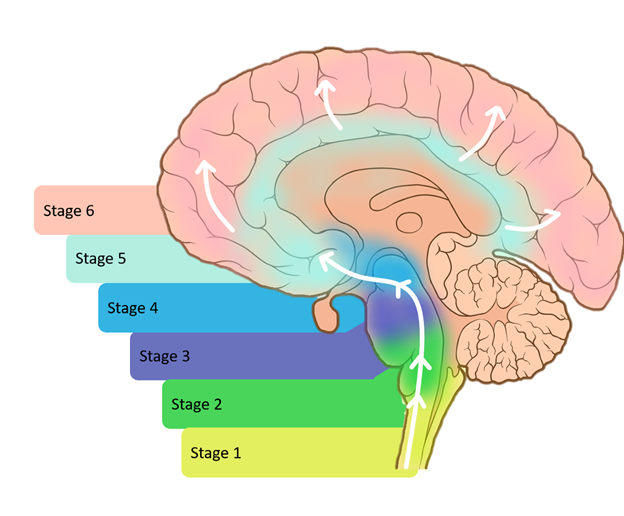
Crucially, Braak’s neuroanatomical work exposed the vagus nerve as the primary conduit for this pathogenic spread, effectively identifying the biological highway that connects the gut to the brain. In line with this, an epidemiological study in Denmark showed that people who underwent vagotomies (surgical removal of the vagus nerve) have a lower risk of Parkinson’s disease.
The Role of Gut Bacteria
Where do these toxic alpha-synuclein aggregates come from? One theory suggests that a common gut microbe, E. coli, produces a protein called curli that enhances the aggregation of alpha-synuclein protein. When Dr. Tim Sampson transplanted a curli-producing E. coli strain into a mouse model of Parkinson’s disease, the mice exhibited considerably worse motor symptoms. Upon closer look, Sampson found that these mice showed more alpha-synuclein aggregation driven by the curli protein.
Building on Sampson’s curli experiment, Dr. Paul Wilmes’ team at the University of Luxembourg discovered that a dietary fiber—long known to shape gut microbiome—affects curli’s impact on Parkinson’s disease progression. When deprived of fiber, the mice showed significantly worse motor impairments compared to those receiving a fiber-rich diet.
Upon closer examination, they found that a lack of fiber shifts the gut microbiome toward bacteria that damage the gut barrier. Typically, when the gut barrier becomes weakened (known as ‘leaky gut’), bacteria and their byproducts can enter the bloodstream, potentially causing widespread inflammation. However, in this study, the ‘leaky gut’ allowed more alpha-synuclein aggregates to spread to the brains of fiber-deprived mice.
Human studies mirror Wilmes’ finding: intestinal biopsies of Parkinson’s patients showed an impaired gut barrier, while exhibiting a higher degree of inflammation in the brain and blood. This inflammatory cascade—likely triggered by both gut-derived toxins and alpha-synuclein aggregates—creates a vicious cycle of neurodegeneration.
While human causation studies are still underway, the emerging evidence paints a clear pathogenic cascade: poor diets disrupt microbial balance, which in turn compromises gut barrier integrity, ultimately accelerating Parkinson’s progression through alpha-synuclein aggregation and inflammation.
Targeting the Gut for Parkinson's Treatment
The gut microbiome’s pivotal role in Parkinson’s disease has opened an exciting new frontier for treatment. Unlike fixed genetic risk factors, our microbial ecosystem offers a dynamic therapeutic target—one that can be reshaped through strategic interventions.
Cutting-edge research is now exploring these interventions:
Diet
In one of the largest and longest studies of its kind, Dr. Xiang Gao’s team at Fudan University followed over 42,000 people for 30 years, carefully observing their intake of ultra-processed foods and looking for early signs of Parkinson’s disease, such as chronic constipation, body pain, or loss of smell. By the end of the study, Gao’s team found that those who regularly ate ultra-processed foods were much more likely to show early symptoms of Parkinson’s disease.
Could changing what we eat help fight Parkinson’s symptoms? A clinical trial from New Zealand suggests it might. Researchers had Parkinson’s patients follow either a low-fat or ketogenic (keto) diet for 2 months. The result is promising—while both groups saw improvements in both motor and non-motor symptoms, the keto diet group showed three times more improvement.
However, this study has a caveat—the small sample size (n = 20/group) prevented the researchers from making definitive claims about the keto diet’s relative effectiveness. While preliminary, this study adds to growing evidence that what we eat may powerfully impact Parkinson’s disease progression.
Fecal Microbiota Transplantation (FMT)
FMT is a medical procedure where a doctor transfers stool from a healthy donor into the gut of a recipient via colonoscopy, enema, or in capsule form (a.k.a. poop pills). This procedure has been commonly used to treat C. difficile infections since 1980.
In Parkinson’s mouse models, FMT with healthy human-derived microbes improves their motor functions and protects against neurodegeneration. However, when applied to humans, the benefits become less clear; while some patients experience modest improvements, most studies report inconclusive outcomes regarding FMT’s therapeutic potential, primarily due to the duration of FMT.
That said, two recent clinical studies published in The Lancet and npj Parkinson’s Disease have shown that extended FMT procedures (lasting more than 6 months) can significantly improve motor function and constipation in Parkinson’s patients. While these findings are promising, this is just the beginning; current efforts now focus on improving donor selection and treatment protocols to maximize clinical benefits.
Probiotics
NIH defines probiotics as “live microorganisms, primarily bacteria or yeast, that are intended to offer health benefits when consumed.” Although promising in theory, several clinical trials have shown that probiotics have no effect or only a mild effect on constipation. Why might that be? Here are the reasons:
- Each gut microbiome is as unique as a fingerprint. Thus, the same probiotic strain will behave differently in different people.
- Probiotics often lose viability before the bottle is opened due to the manufacturing process and storage.
- Upon consumption, the probiotic strains must compete with trillions of well-established native gut microbes for resources. Even with daily dosing, these probiotic invaders rarely manage to establish permanent colonies in our complex gut ecosystem.
The Future of Parkinson's Treatment
The growing understanding of Parkinson’s as a ‘gut-first’ disease transforms how we approach its prevention and treatment. Although microbiome-targeted therapies remain experimental, one thing is clear: early symptom monitoring and maintaining gut health (through a healthy diet, microbiome care, and exercise) may be our best chance at slowing Parkinson’s disease progression.
The future of combating this debilitating disease may just begin in our gut.
Glossary
- Alpha-synuclein: A protein that, when misfolded and clumped together, becomes toxic to neurons and is the hallmark of Parkinson's disease
- Curli protein: A protein produced by certain bacteria like E. coli that can trigger the clumping of alpha-synuclein
- Enteric nervous system: The gut's independent network of neurons, sometimes called the "second brain"
- Substantia nigra: The brain region that produces dopamine and is primarily affected in Parkinson's disease
- Vagus nerve: The major nerve connecting the gut and brain, serving as a pathway for disease spread