Have any of you ever seen E.T. the Extraterrestrial? Or maybe remember the Little Green Men from the Toy Story series? Moving away from Hollywood perhaps, the first modern “Unidentified Flying Object” was spotted in 1947, making headlines as a “flying saucer.” Since then, humans have been baffled by shiny, moving objects in the sky with the internet exponentially fueling alien conspiracy theories.
While this exploration is fascinating and I love a mystery too, let’s talk about the science behind the possibilities of extraterrestrial life: Does it exist? Could it exist? In order to understand how to even approach these questions, we need to first question where life as we know it comes from. A question Stanley Miller first set out to answer in 1953.
The Miller-Urey experiment as we know of it now, attempted to simulate the environment of Earth’s early conditions to test whether or not organic molecules (molecules composed of carbon and hydrogen) can be produced from the inorganic compounds believed to have been present1. Organic molecules are the building blocks of life— a family of molecules that exist in all living forms. Derived from the ideas of Russian biochemist Aleksandr Oparin and British physiologist J.B.S. Haldane, who both suggested that organic molecules could be formed by inorganic substances under specific environmental conditions, the Miller-Urey experiment was used to prove the fundamental basis of chemical evolution: complex chemical compounds come from simple compounds.
Along with his supervisor Harold C. Urey, Miller set up an experimental system meant to recreate the environmental conditions of “early Earth.” At the time, most of the scientific community believed this environment to be composed of ammonia, methane, hydrogen, and water vapor. In order to recreate the environmental conditions, they basically put a “soup” of these ingredients together in a closed system so materials could evaporate, gasses could mix, and their materials could interact.
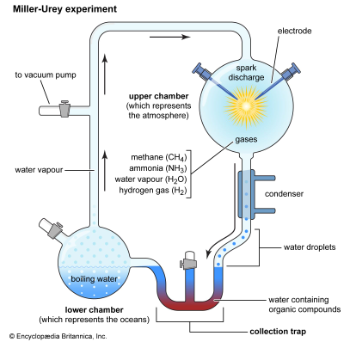
Experimental Set-Up, Britannica
One flask contained liquid water which was boiled constantly throughout the experiment. This water vapor traveled upwards to another flask which contained the other three gasses: ammonia, methane, and hydrogen. Electrodes placed in the upper flask provided an energy source for reactions. After the gasses reacted, they condensed and collected. The resulting liquid was tested for organic molecules.
So what did they find?
While they didn’t find mini humans in the flask, they did discover several amino acids, which are a type of organic molecule that builds proteins. Other scientists who have since then replicated this experimental protocol and have altered it using different energy sources, all came to the same conclusion: amino acids can be formed from the inorganic compounds expected to have been present in early Earth and its variations. In later editions, scientists detected up to 33 amino acids— over half of the ones that we know commonly appear in ourselves and other life on Earth.

Amino Acid Cartoon, The Amoeba Sisters
Recent developments and discoveries have corrected initial beliefs about early Earth. For example, it was found that carbon dioxide and nitrogen may be more accurate than ammonia and methane if the experiment were rerun today2. However, the main idea holds true: organic molecules can arise from inorganic compounds. Follow-up studies more than 60 years after its initial run have even shown that the primordial soup and its amino acids are sufficient for certain simple bacterial growth3.
In some lucky way, under some lucky circumstances, “life” can truly just happen.
REFERENCES
- [1] Akre, K., & Rafferty, J. P. (2024, November 28). Miller-Urey experiment. Encyclopædia Britannica. https://www.britannica.com/science/Miller-Urey-experiment
- [2] U.S. Department of Energy Office of Science User Facility. Argonne National Laboratory. (n.d.). https://www.aps.anl.gov/APS-Science-Highlight/2021-02-22/earths-early-toxic-atmosphere
- [3] Xie, X., Backman, D., Lebedev, A. T., Artaev, V. B., Jiang, L., Ilag, L. L., & Zubarev, R. A. (2015, September 28). Primordial Soup was edible: Abiotically produced Miller-Urey mixture supports bacterial growth. Nature News. https://www.nature.com/articles/srep14338