What is Biotechnology? Rewriting Life's Blueprints
Curiosity killed the cat, but it also helped scientists almost make one from scratch. Sounds crazy, right? But think about it: What is a cat? Well if you're anything like me, you'd say it's a furry ball of attitude that believes humans exist to serve it. Fair. But at its core, a cat is just an animal. And like all animals, like all life, it’s built from cells.
Remember our cellular cities from Chapter 1? Cells are just tiny, organized cities of life. So here’s a thought. What if I told you that scientists have learned not just to visit these cities, but to redesign them entirely? This is where biotechnology(1) comes in—the art and science of rewriting life's instruction manual.
Core of Biotechnology: What do Scientists actually Do?
Humans naturally aim for more. (Selfish? Maybe.) So, when scientists saw how microorganisms were producing useful chemicals, they thought: why not use that for ourselves? What if we put those abilities into other organisms? What happens if we tweak nature to suit our needs?
These questions gave rise to biotechnology. And what scientists do is they take cells, keep the useful parts, remove or modify what’s harmful, and create products that help us. Sounds like a lot? It is. But as someone wise once said, “When in doubt, look intelligent.” So, let’s try and actually understand it.
Blueprint of Cells: Our DNA
If we really can change our cells to help humans, then we need a plan. A strong one. But what if I told you that the plan is already inside us, written in the cells themselves? It might sound like a child’s dream — but it’s true.
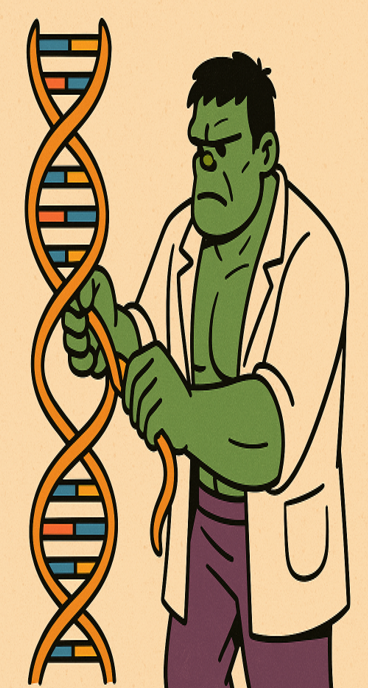
This plan, or blueprint, is what we call DNA. You can picture DNA as a ladder. (2) Imagine the Hulk, in one of his fits of rage, twisting that ladder. The Hulk is gone now, but the ladder remains. That twisted ladder is our DNA - and it's not random. The steps of the ladder are arranged in a very specific order. And this order is not numeric. They’re made up of four chemical bases: adenine, thymine, cytosine, and guanine. (We’ll save the details of how they pair up for another time.) What matters here is the order. That order is everything. It’s what cells read as their “action plan.”
Think of it this way: each step of the ladder is like a step in a recipe or instruction manual. Skip the first step, and the result will not be the same. Likewise, you can’t scramble the bases and expect the same outcome. The sequence determines which proteins and cell components are made.
And so my question returns: can we change the steps — rearrange parts of the ladder — but still keep the overall blueprint so we can get the outcome we want?
The simple answer: yes.
Functioning of Biotechnology: Adventures of Dr. Hulk
Now let’s run with our imagination. What if the Hulk didn’t like the stairs and decided he’d rather take the elevator instead (Endgame reference, anyone?). Hulk is also a scientist, and when he looks closely, he realizes that stairs and elevators, while different, serve the same purpose: transport.
So in his lab, Hulk reasons: if both serve the same function, then maybe he can start with the blueprint for stairs and tweak it — cut here, add there — until he creates an elevator.
That’s essentially what biotechnology does. It takes an existing blueprint — our DNA sequence — understands its primary function, and makes intentional changes so that the result is a more effective product.
Golden Rice: The Gold Mine of Biotechnology
Most people, when talking about biotechnology, bring up insulin. But let me tell you something even more interesting.
In many parts of the world, entire diets revolve around rice. The problem? Rice doesn’t contain vitamin A — and vitamin A is crucial for healthy vision.
So imagine someone whose diet is almost entirely rice, with no other source of vitamin A. Over time, that person could develop severe eye problems, and in many cases, even go blind. This isn’t just a thought experiment — it’s a real issue affecting hundreds of thousands of people around the world.
Here’s where biotechnology steps in like a hero. Scientists discovered that beta-carotene — the nutrient our bodies use to make vitamin A — is naturally found in corn and certain bacteria. So, what did they do? They took the genes responsible for beta-carotene production and inserted them into rice plants.
After many failed attempts, they finally succeeded. The result was a new type of rice, golden-brown in color(3), and most importantly, rich in vitamin A. This “Golden Rice” has the potential to reduce blindness in populations where rice is a staple food and vitamin A deficiency is widespread.
Modern Family - More like Modern Biotechnology
Back in the old days, when Hulk was still just Bruce Banner, the technology for editing DNA was… well, let’s say it was like my grandfather’s Nokia phone. Reliable, useful, and indestructible — but also slow and clunky. It got the job done, just not very efficiently.
Now, times have changed. Bruce has become the Hulk, the Nokia has been replaced by sleek smartphones, and DNA editing has had its own upgrade. Instead of randomly tinkering with DNA sequences, we now have precise molecular scissors that can cut DNA quickly and accurately. This tool is called CRISPR(4).
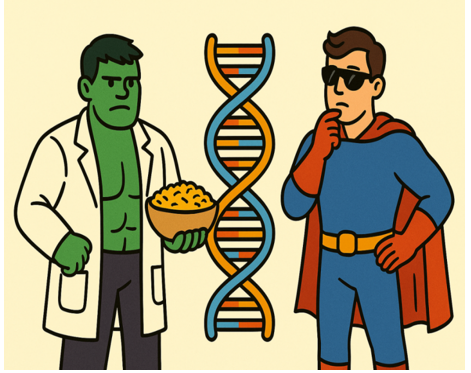
With CRISPR, Hulk doesn’t have to smash blindly anymore. He can act with precision. Suddenly, fixing Superman’s laser-eye problem isn’t out of reach. Producing insulin for Captain America? Possible. Designing enzymes for Black Widow’s detergents? Absolutely.
In short: gene editing has leveled up. Today, Hulk isn’t swinging wildly — he’s striking with accuracy. And the world is here for it.
The Future of Biotechnology
Now let’s take a deep breath and zoom out for a moment. We’ve been talking a lot about DNA — its bases, its sequence, and how we can edit it for our benefit. But let’s step back and ask a bigger question: why do we need biotechnology at all?
In a nutshell, biotechnology exists for one reason — to benefit humans(5).
Dr. Hulk knows there will always be challenges to face and enemies to fight. Sometimes it’s Thanos, sometimes it’s COVID. It could be malnutrition, or maybe Wanda going on a rampage. No matter the problem, there’s always something broken to fix and something new to protect.
The world is constantly evolving, and with it, our needs evolve too. Whether it’s health, food, or survival, biotechnology gives us tools to improve quality of life.
So in this story, Dr. Hulk isn’t just smashing — he’s a visionary. And we? We’re following his lead.
Until Next Time
In the end, it doesn’t matter whether you’re an Avenger, a biotechnologist, or simply a curious reader. What matters is that biotechnology is real — and it’s already shaping our world.
There are many “Dr. Hulks” out there, each still discovering and experimenting, and their work is worth paying attention to. Biotechnology isn’t just about solving problems — it’s about understanding how life itself works(6), and how that knowledge can be used to benefit us all.
If there were no real-world limits, what would you create?
- National Institute of Biomedical Imaging and Bioengineering. (n.d.). Biotechnology. National Institutes of Health. https://www.nibib.nih.gov/science-education/science-topics/biotechnology
- Watson, J. D., & Crick, F. H. C. (1953). Molecular structure of nucleic acids: A structure for deoxyribose nucleic acid. Nature, 171(4356), 737–738. https://doi.org/10.1038/171737a0
- Potrykus, I. (2001). Golden rice and beyond. Plant Physiology, 125(3), 1157–1161. https://doi.org/10.1104/pp.125.3.1157
- Doudna, J. A., & Charpentier, E. (2014). The new frontier of genome engineering with CRISPR-Cas9. Science, 346(6213), 1258096. https://doi.org/10.1126/science.1258096
- Baeshen, N. A., Baeshen, M. N., Sheikh, A., Bora, R. S., Ahmed, M. M., Ramadan, H. A. I., Saini, K. S., & Redwan, E. M. (2014). Cell factories for insulin production. Microbial Cell Factories, 13, 141. https://doi.org/10.1186/s12934-014-0141-0
- World Health Organization. (2021). Global guidance framework for the responsible use of life sciences: Mitigating biorisks and governing dual-use research. https://www.who.int/publications/i/item/9789240056107
All images are AI-generated.