
What a Brain-Computer Interface Actually Is
A brain–computer interface, or BCI, is a tool that helps the brain send a message to a computer. It listens to tiny electrical signals produced when a person thinks about moving, speaking, or focusing on a task. These signals continue even when the body cannot respond. A BCI picks up the signal, interprets it, and turns it into an action on a screen or device.
Researchers first explored BCIs to help people who had lost movement or speech. Early experiments in the 1970s showed that the brain’s signals were still active even after severe injury. Modern BCIs build on these early findings with more sensitive tools and better computer algorithms.
Two Main Types of BCIs
There are two broad types of BCIs: non-invasive and invasive.
Non-invasive BCIs
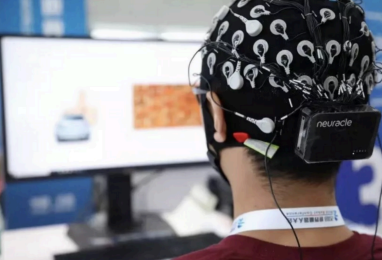
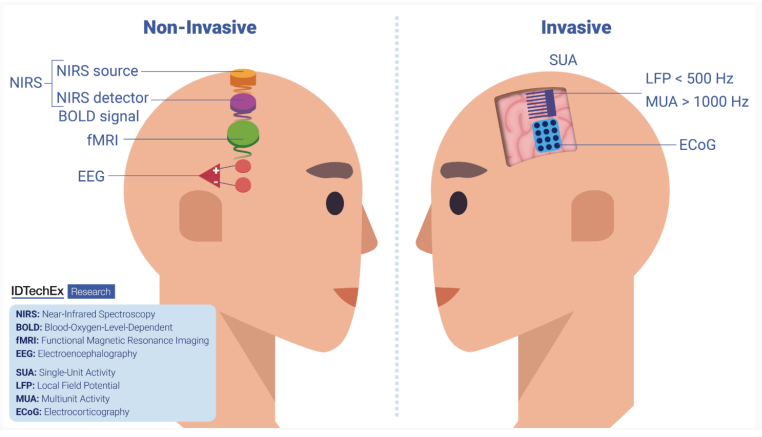
These systems sit outside the skull. They usually look like a soft cap or a headset. The sensors read electrical activity from the scalp, similar to a medical EEG test. They are safe, painless, and widely used in research centres.
A good way to imagine this is to think about listening to music from the other side of a wall. You can sense the beat and volume, but not every detail. Non-invasive BCIs work in a similar way. They pick up broad patterns that can be translated into simple computer commands.
These devices already allow people to move a cursor, make selections, or play basic games.
Invasive BCIs
Invasive BCIs use tiny electrodes placed directly in the brain. Because they sit very close to the neurons, the signal is much clearer. This makes it possible to control robotic arms, wheelchairs, and communication tools with far more precision.
These systems require surgery, so they are used only in clinical research settings. Even so, they have allowed people with paralysis to grasp objects with robotic hands or type at speeds far faster than older assistive technologies.
Can BCIs Read Thoughts?
No. BCIs do not read private thoughts, memories, or emotions. They detect patterns linked to specific tasks, such as trying to move a hand or focusing on a letter on a screen.
If the brain were a large library, a BCI would only see one reading room, and only when someone turns on the light. It cannot access the rest of the building.
Why BCIs Are Improving So Quickly
Recent progress comes from several scientific areas coming together:
● Sensors have become more sensitive.
● Machine learning can recognise patterns more accurately.
● Computers can process signals in real time.
● Devices have become smaller and more comfortable.
These improvements mean that BCIs now work faster, require less training, and feel more intuitive.

How BCIs Are Used Today
BCIs are having the greatest impact in medicine.
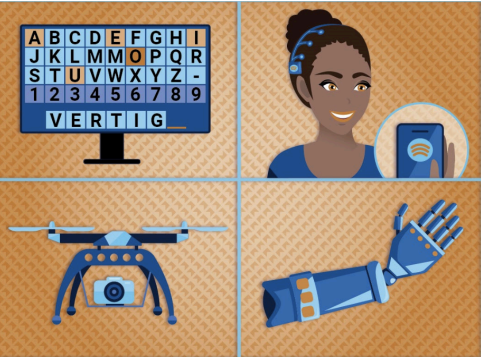
- Restoring movement - People with spinal cord injuries and neurological disorders can control robotic arms or digital interfaces.
- Restoring communication - Individuals with conditions such as ALS can type messages or use a digital voice.
- Rehabilitation - Some research groups use BCIs to support motor recovery after stroke.
- Basic science - Neuroscientists use BCIs to learn how the brain produces movement, attention, and decision making.
These uses may not always reach the news, but they make a real difference in daily life.
What the Future May Look Like
Researchers are exploring whether BCIs could help surgeons perform hands-free tasks, assist astronauts in complex environments, or interact with future augmented reality systems.
These ideas are still early. Questions about long-term safety, precision, privacy, and comfort need to be answered. For now, the most reliable and responsible uses remain in healthcare and scientific research.
Why BCIs Matter
BCIs give the brain a new path to communicate. They do not read thoughts. They help restore connection. They turn faint electrical signals into meaningful action, especially for people who have lost the ability to move or speak.
As the technology improves, it may open new possibilities for independence, mobility, and learning. The most inspiring results are already here, one signal at a time.
Key Points
● A BCI helps the brain communicate with a device.
● Non-invasive BCIs sit outside the skull. Invasive BCIs use implanted electrodes.
● BCIs do not read thoughts. They detect specific patterns linked to actions.
● Advances in machine learning and sensors have improved accuracy.
● The strongest impact today is in medicine and communication support.
References and Further Reading
- Lebedev, M. and Nicolelis, M. (2006). Brain–machine interfaces: past, present and future. Trends in Neurosciences. https://doi.org/10.1016/j.tins.2006.07.004
- Wolpaw, J. and Wolpaw, E. (2012). Brain–Computer Interfaces: Principles and Practice. Oxford University Press. https://global.oup.com/academic/product/brain-computer-interfaces-9780195388844
- Hochberg, L. et al. (2012). Reach and grasp by people with tetraplegia using a neurally controlled robotic arm. Nature. https://www.nature.com/articles/nature11076
- National Institutes of Health (NIH). “Decoding Inner Speech from Brain Signals. https://www.nih.gov/news-events/nih-research-matters/decoding-inner-speech-brain-signals
- BrainGate Research Consortium. Clinical trials, research, and publications. https://www.braingate.org
- UCSF Weill Institute for Neurosciences. “How a Paralyzed Man Moved a Robotic Arm With His Thoughts.” - https://www.ucsf.edu/news/2025/03/429561/how-paralyzed-man-moved-robotic-arm-his-thoughts