The rare earth elements have one of the most misleading names in chemistry. They aren't earths. And they aren't particularly rare. So, what are they, and why does everyone suddenly care? For the past few years, we have heard the term "rare earth elements" in the media more and more often, especially in the context of geopolitical troubles, sometimes even as negoation bargaining chips. Yet do we really know what those are? And why do we even need them?
What are the Rare Earth Elements?
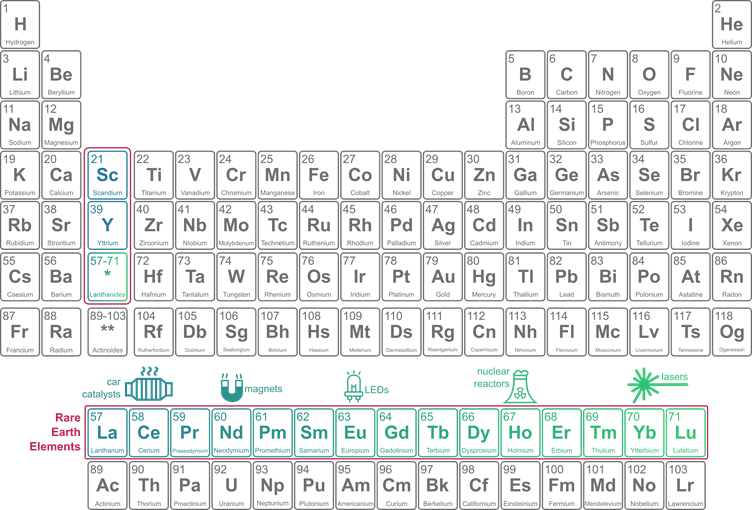
Generally speaking, the rare earth elements are a group of 17 different chemical elements, spanning the so-called lanthanides plus scandium and yttrium. Now if you think back to the old days of actual printed periodic tables, those could be found in the fold-ins, or stuffed somewhere to the bottom – so did we ever actually look at them closely? Yet they are found in an abundance of our modern world applications, spanning fuel cells, X-ray imaging, lasers, (car) catalysts, magnets, TVs, nuclear reactors, in medicine, and many many more, highly specialized applications.
Why they are not earths, but metals
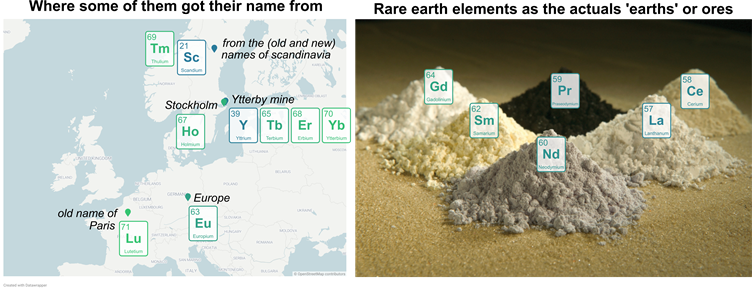
To now understand why we refer to them as “rare earth elements”, we have to understand how we first found them, and the language we used back then. When the rare earth elements were first found starting in the late 18th century, they were found as the respective ores, not as elements, which are chemically referred to as oxides. Back in the days, these oxides were for a lack of modern naming conventions called “earths”. Most rare earth elements were initially found as the corresponding oxides, or earths, the name just stuck. A lot of the names of rare earth elements are actually derived from where they were first found: Yttrium was first discovered in a mine in Ytterby, Sweden, while Scandium is named after Scandinavia or Holmium and Lutetium are named after the Latin names for Stockholm and Paris.
Are they really that rare?
The second misconception we have about these elements is that they are actually rare. If we think about rare elements, we often think about expensive things like silver or gold. Now generally, the rare earth elements are not really rare – Cerium is about as abundant as copper or zinc, Neodymium, Lanthanum, Yttrium or Scandium are about as rare as lead, and even the more rare elements like Terbium, Thulium, or Lutetium are far still more abundant than silver, gold or platinum. What actually makes these elements rare is that there are very few places where they are abundantly found. And in the places that do have lots of rare earth elements, they are actually found all mixed with each other. This is due to their very similar chemical properties, which makes production and separation very difficult and expensive. Most of the rare earth elements we use today are produced as side products of other chemical processes.
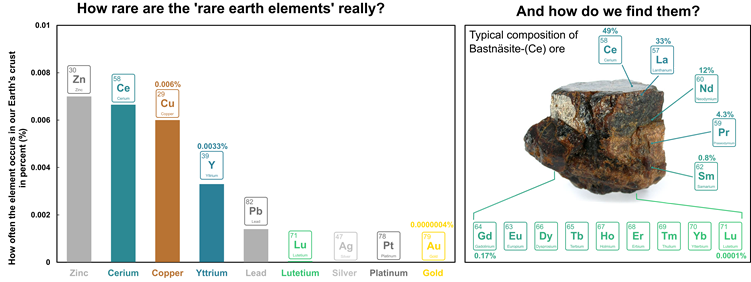
And where do we find them then?
Since the rare earth elements are used in so many high-tech applications, they play an important role in our modern day life. Without rare earth elements, we would be missing a lot of important tools in a variety of aspects of our life – from everyday goods like TVs to medicine and energy production. Until the late 2010s, China has been number 1 producer of the rare earth elements, because it has some of the biggest and most profitable mines (but even here, the amount of rare earth elements is only between 3 – 5%). Outside China, countries like Australia, Greenland, or Canada possess large deposits that will play an important role in the future.
To come back to our initial questions, I hope you found some answers. The rare earth elements are actually not earths, but a series of metals in the periodic table. And they aren’t actually that rare, they are just hard to find, and expensive to separate and purify because they are so similar to each other. Yet our modern life depends on the rare earth elements, and we find them in almost every aspect of modern life.
Sources:
Picture of rare earth element oxides: By Peggy Greb, US department of agriculture -http://www.ars.usda.gov/is/graphics/photos/jun05/d115-1.htm, Public Domain, https://commons.wikimedia.org/w/index.php?curid=10512749
Abundance of elements: David R. Lide, ed., CRC Handbook of Chemistry and Physics, Internet Version 2005, CRC Press, Boca Raton, FL, 2005.
Picture of Bastnäsite and composition: https://www.mindat.org/photo-155010.html, https://de.wikipedia.org/wiki/Bastn%C3%A4sit