The search for cleaner energy
Imagine filling your car with a fuel that produces nothing but water. No smoke, no exhaust fumes, and no carbon dioxide. It sounds like something from the future, but scientists are already working to make it possible through hydrogen energy.
As concerns about climate change continue to grow, researchers are searching for cleaner alternatives to fossil fuels. One of the most talked-about possibilities is hydrogen.
What exactly is hydrogen?
Hydrogen may sound like a rare, high-tech fuel, but it is actually the most abundant element in the universe. It is found everywhere, from the stars to one of the most familiar substances on Earth: water. However, hydrogen is rarely found on its own in nature. It is usually bonded to other elements, like oxygen in water (H₂O).
To use hydrogen for energy, it must first be separated and collected. This is why scientists often describe hydrogen as an energy carrier rather than an energy source. Like a battery, it stores energy that was put into it somewhere else, and how that energy was produced makes a big difference to its environmental impact.
Making hydrogen: different methods
Today, most of the world’s hydrogen is made using a process called steam methane reforming (SMR). In this process, natural gas is reacted with high-temperature steam to extract hydrogen. It is widely used because it is relatively cheap, but it produces carbon dioxide as a by-product, which reduces its environmental benefits.
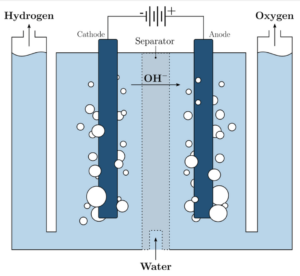
A cleaner method is electrolysis. Electrolysis uses electricity to split water into hydrogen and oxygen. If that electricity comes from renewable sources like wind or solar power, the hydrogen produced is called green hydrogen. This means hydrogen can be made without directly releasing carbon dioxide into the atmosphere.
Right now, only a small share of hydrogen is produced this way. This is why hydrogen is often described as a “clean energy option with a catch”: its impact depends heavily on how it is made.
How hydrogen produces energy
Hydrogen becomes useful through a technology called a fuel cell.
A fuel cell generates electricity through a chemical reaction between hydrogen and oxygen. The only by-products of this reaction are water and heat.
You can think of a fuel cell as something like a battery, but instead of being charged once and used up, it keeps producing electricity as long as hydrogen is supplied.
This makes it very different from traditional engines, which burn fuel and release gases like carbon dioxide.
Where hydrogen is already being used
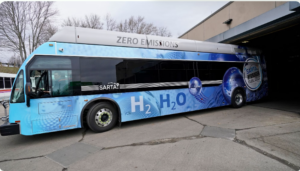
Hydrogen technology is not just theoretical. It is already being used in the real world, including:
- Hydrogen-powered buses and cars
- Industries such as fertilizer production and oil refining, which already rely on hydrogen
- Backup power systems
- Warehouse equipment like fuel-cell forklifts
In these cases, hydrogen is valued not only for being cleaner at the point of use, but also for being practical in specific situations.
For example, hydrogen fuel-cell forklifts can be refuelled in minutes, while battery-powered forklifts may need hours to recharge, which makes hydrogen useful in large, busy warehouses.
The challenges of hydrogen energy
Even though hydrogen is promising, it is not without problems.
One major challenge is cost. Producing green hydrogen requires large amounts of electricity and specialized equipment, which can be expensive.
Another challenge is storage and transport. Hydrogen is a very light gas, so it must be compressed or cooled into a liquid to be stored efficiently. This requires special infrastructure, such as pipelines and fuelling stations, that does not yet exist in most places.
There is also an energy trade-off. Some energy is lost each time electricity is turned into hydrogen and then back into electricity, so for some uses, like everyday cars, using a battery directly can be more efficient.
Because of these challenges, hydrogen is not yet widely used in everyday life.
Why scientists are still interested
Despite these challenges, hydrogen continues to attract attention because of its potential.
If production becomes cheaper and infrastructure improves, hydrogen could play a major role in reducing global emissions. It can work alongside renewable energy sources like wind and solar, especially in industries that are difficult to electrify, such as steelmaking, shipping, and heavy transport.
Instead of replacing all energy sources, hydrogen may become one part of a larger clean energy system.
Final thoughts
Hydrogen energy is a good example of how science often works: a promising idea with both strong advantages and real challenges.
Through my studies in environmental chemistry, I found it interesting that something as simple as splitting water could become part of the solution to global energy problems.
Hydrogen may not be a complete answer to our energy needs, but it could become an important part of a cleaner future.
Key Takeaways
- Hydrogen is an energy carrier: how clean it is depends on how it is produced
- Electrolysis powered by renewable electricity produces green hydrogen, while most hydrogen today is made from natural gas, which releases carbon dioxide
- Fuel cells generate electricity with water and heat as the only by-products
- Hydrogen is already used in transport, industry, and warehouse equipment
- Cost, storage, infrastructure, and energy losses are major challenges