“How inappropriate to call this planet Earth when it is quite clearly Ocean.” ~ Arthur C. Clarke
Science is full of paradoxes. At times, humanity understands distant worlds better than the one lying right beside us. We know the surface of the Moon and Mars better than the floor of our own ocean. That sounds almost unbelievable when we remember that the ocean covers about 71% of Earth’s surface. And yet, according to current estimates, more than 80% of the ocean remains insufficiently explored, especially its deep-sea regions.
The ocean feels familiar to us. We see it on maps, admire it from the shore, and read about storms, tides, and marine life. But in reality, it remains one of the most mysterious realms on our planet. Beneath its surface lies a vast world about which humanity still knows remarkably little.
Perhaps that is why the sea has held a special fascination for me since childhood. When I was young, and for many years before leaving to study abroad, my family spent almost every summer by the sea. That was where our holidays unfolded, and where I first felt that deep sense of wonder inspired by the water. Of course, the sea is not the same as the ocean, yet it became my first window into this immense and enigmatic world.
At first glance, the ocean appears calm and almost motionless. From the shore - or even from space - we mainly see its surface: waves, ripples, and sometimes storms. But that is only its outer skin. In reality, the ocean is never still. Vast masses of water are constantly in motion, forming powerful currents that can cross entire ocean basins and extend for thousands of kilometers.
These flows are often described as rivers within the ocean. And this is more than a poetic metaphor. Like rivers on land, they have direction, speed, and relatively stable pathways. The largest among them are so powerful that they can carry more water than all the rivers on Earth combined.
What Are Ocean Currents?
These “rivers within the ocean” are known as ocean currents - long, directed flows of seawater that move through the oceans like vast, slow-moving rivers. They can extend for thousands of kilometers, transport enormous volumes of water, and play a crucial role in redistributing heat, salt, and nutrients across the planet.
In simple terms, scientists usually distinguish two main types of ocean currents: surface currents and deep currents.
Surface currents form in the upper layers of the ocean, typically within the top few hundred meters. Their movement is largely driven by winds that blow continuously across the ocean’s surface. In this sense, the ocean behaves somewhat like Earth’s atmosphere: winds push the upper layers of water, creating large-scale flows. Over time, these flows organize into vast circular systems known as ocean gyres, which have a significant influence on climate and weather patterns.

Swirling parcels of water, called ocean eddies, spin off from the warm Gulf Stream, the powerful northward-flowing current that hugs the U.S. East Coast. This visualization was generated by a numerical model that simulates ocean circulation. WHOI researchers study ocean currents, like the Gulf Stream, and their behavior.
Deep currents, by contrast, move through the deeper layers of the ocean. Their formation is primarily driven by differences in temperature and salinity. Colder and saltier water becomes denser and sinks, while warmer and less salty water is lighter and rises toward the surface. This process can be compared to the circulation of water in a heated pot: warm water rises, cold water sinks, and continuous movement develops. In the ocean, a similar circulation occurs much more slowly, yet it spans enormous distances. On a planetary scale, it forms the global system of water movement known as thermohaline circulation.
The scale of water movement in the ocean is truly immense. Some currents transport millions of cubic meters of water every second. For comparison, the volume of water carried by the world’s largest river - the Amazon - represents only a small fraction of the flow of the largest ocean currents.
Among the most powerful and well-known currents on Earth are several key systems.
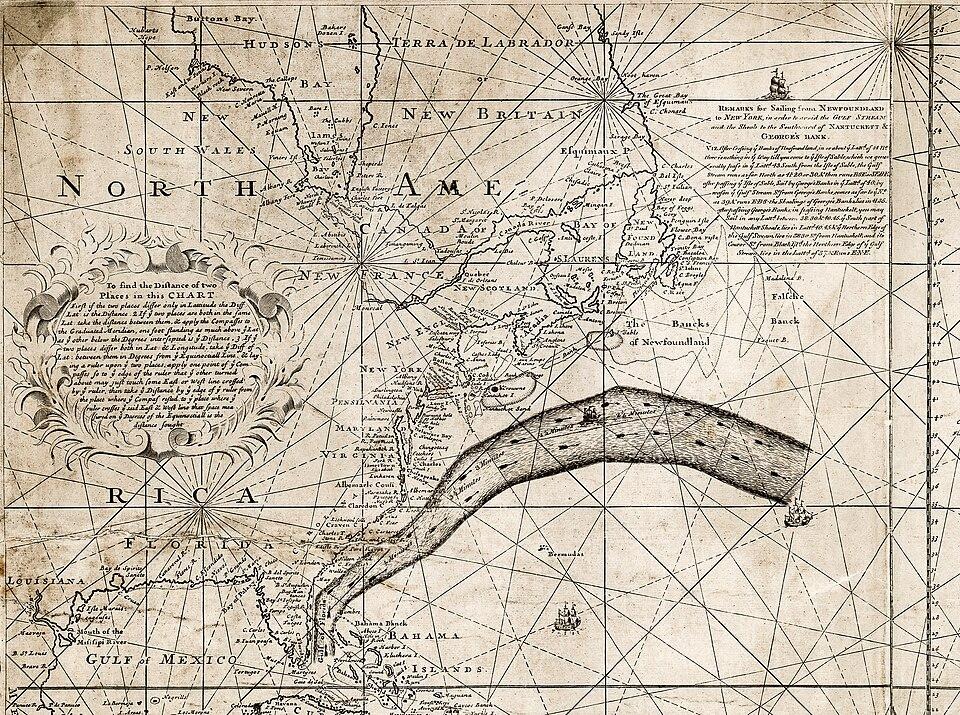
One of them is the Gulf Stream, a warm current in the Atlantic Ocean that plays a major role in shaping the climate of Europe and the North Atlantic region. Interestingly, the study of the Gulf Stream did not begin in a laboratory but with a simple maritime mystery. In the 18th century, Benjamin Franklin noticed that ships crossing the Atlantic in one direction traveled faster than in the other. Behind this difference lay an invisible force - a powerful warm current flowing across the ocean. By questioning sailors and whalers, Franklin realized that this was not a coincidence but a consistent pattern. In 1769, one of the first maps of the Gulf Stream was published, marking one of the earliest scientific descriptions of a “river” within the ocean.
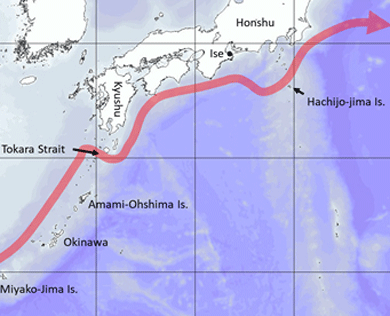
In the Pacific Ocean, a similar role to that of the Gulf Stream is played by the Kuroshio Current, sometimes referred to as the “Black Current.” It transports warm waters along the eastern coast of Asia and influences the climate of Japan and neighboring regions.
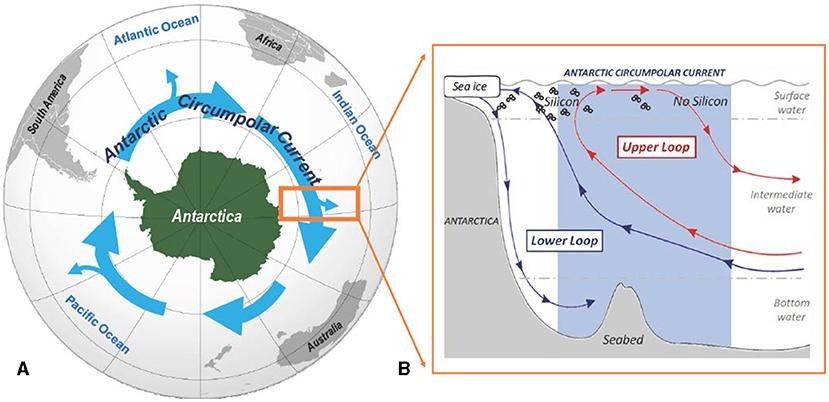
Even more impressive in scale is the Antarctic Circumpolar Current (ACC). This is the only current on Earth that completely encircles the planet, flowing uninterrupted around Antarctica. It connects the waters of the Atlantic, Pacific, and Indian Oceans and plays a crucial role in the global circulation of the world’s oceans.
How the “Rivers Within the Ocean” Form
Ocean currents do not arise randomly. Their formation is shaped by several physical forces that act together and reinforce one another. The most important among them are winds, Earth’s rotation, and differences in temperature and salinity. Together, these forces create a complex system of motion that allows ocean waters to travel thousands of kilometers across the globe.
Wind
One of the primary drivers of surface currents is the wind that continuously blows over the ocean’s surface. As wind moves across the water, it transfers part of its energy to the ocean. As a result, the upper layer of water begins to move slowly in the same direction as the airflow. Particularly important are the trade winds, which blow steadily across tropical regions, as well as the westerlies, characteristic of the temperate latitudes. These global wind systems have existed for thousands of years and help shape stable patterns of surface water movement.
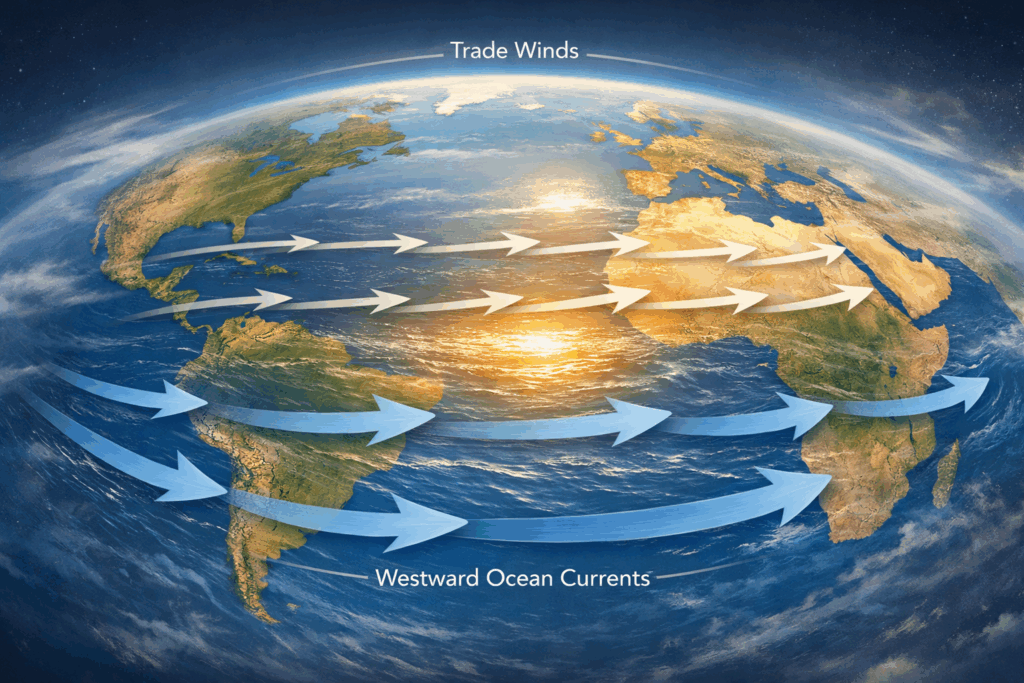
Over time, the wind effectively begins to “push” vast masses of water, forming broad currents that can span entire ocean basins. Many of the major surface currents originate in this way.
Earth’s Rotation
However, the movement of water in the ocean does not follow the wind direction exactly. Another important factor influences it: Earth’s rotation. Because the planet rotates, moving masses of water are deflected from their original paths. This phenomenon is known as the Coriolis effect. In the Northern Hemisphere, currents are deflected to the right, while in the Southern Hemisphere, they are deflected to the left.
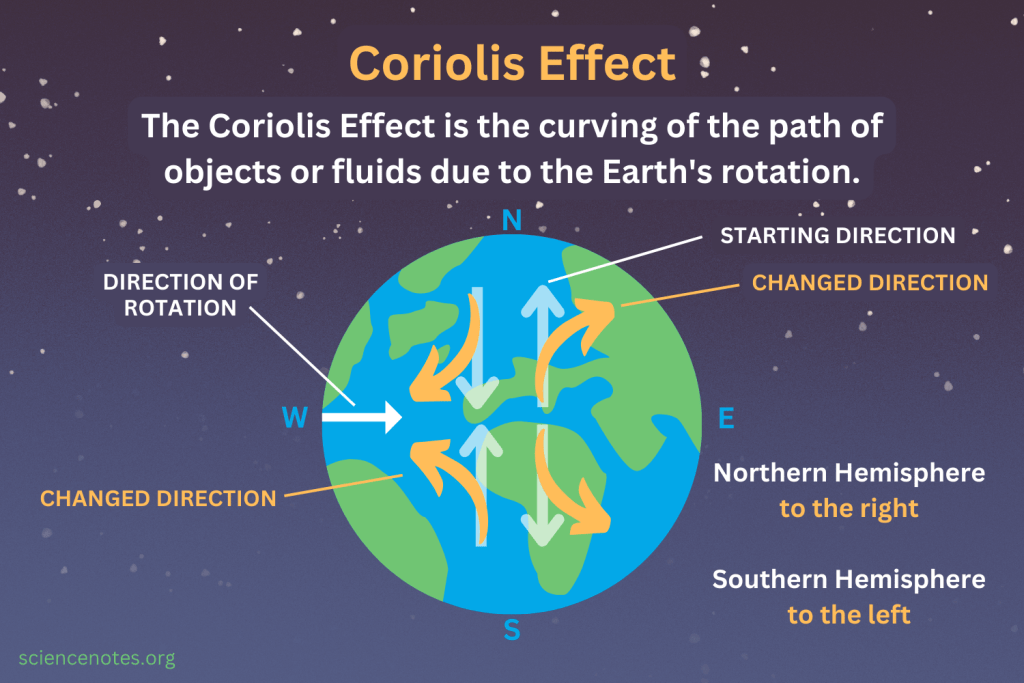
As a result of this deflection, ocean currents begin to curve and gradually form large circular systems of water movement known as ocean gyres. Thanks to the Coriolis effect, ocean currents do not move randomly but instead follow stable and predictable pathways.
Differences in Temperature and Salinity
In addition to wind and Earth’s rotation, another important factor influencing ocean circulation is the density of seawater. Water density depends primarily on temperature and salinity. Colder water becomes denser and sinks, while warmer and less salty water is lighter and rises toward the surface. These differences create slow but powerful movements of water in the deep ocean. This process forms deep ocean circulation, which connects different ocean basins and creates a global system of water movement. Scientists refer to this system as thermohaline circulation - from the words thermo (temperature) and haline (salinity). Although deep currents move much more slowly than surface currents, their impact on the planet is enormous. They help transport heat, oxygen, and nutrients between different parts of the ocean and play a crucial role in maintaining Earth’s climatic balance.
What Happens If Ocean Currents Change?
Ocean currents often appear stable and reliable. For long periods, they maintain their primary pathways, linking different parts of the planet. But what would happen if this complex circulation pattern began to change? And how easily could such changes occur?
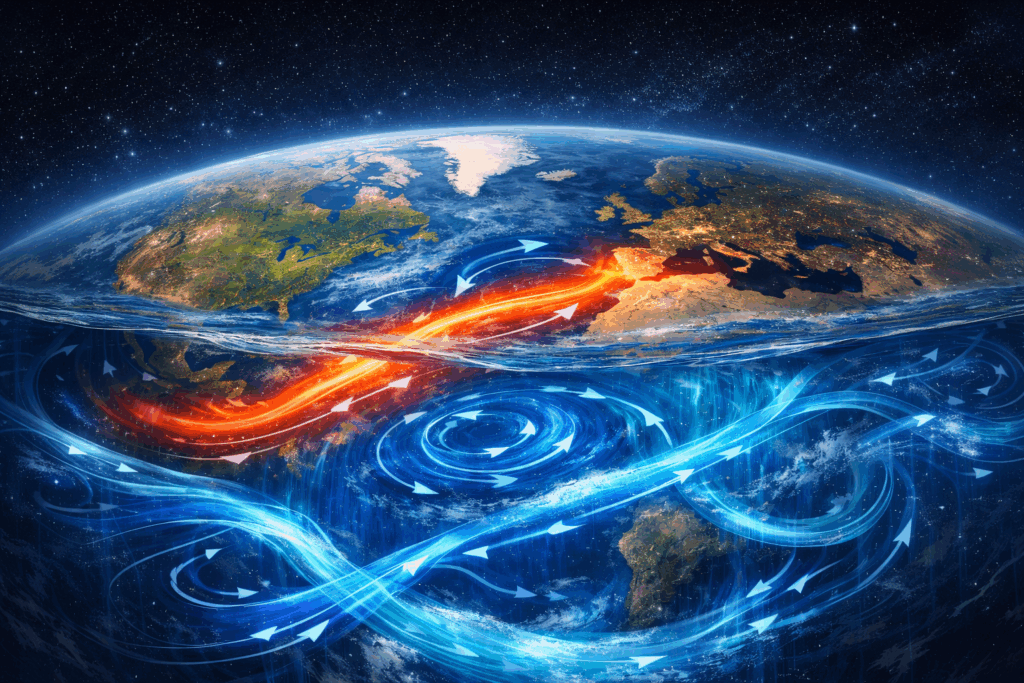
If the global system of ocean circulation were to shift, it might initially seem that a change in one part of it would affect only a specific region of the ocean. In reality, however, these flows form a single interconnected network. Because of this, even relatively small changes in one part of the system can influence water movement in distant regions. If one of these flows weakens, accelerates, or changes direction, the most immediate effects are seen in the transport of heat. The ocean acts as a vast distributor of energy, carrying warm water from low latitudes toward colder regions and helping moderate temperature differences across the planet. Changes in this mechanism could alter regional temperatures, precipitation patterns, and weather systems.
At the same time, recent research suggests that the global ocean circulation system may be more resilient than previously thought. Other oceanic processes can sometimes compensate for the weakening of individual currents, helping maintain the overall stability of the circulation network.
Paleoceanography
Understanding the movement of water through the world ocean requires insights from several scientific disciplines, particularly oceanography, climatology, geophysics, and marine geology. Each of these helps explain why these processes remain stable and what role they play in the life of the planet. There is a particularly fascinating branch of science known as paleoceanography, which focuses on the study of ancient oceans and their circulation. In essence, it is an attempt to reconstruct the history of the world ocean based on the traces it has left in nature.
To understand how ocean waters moved thousands or even millions of years ago, scientists turn to what can be described as natural archives. These archives include sedimentary deposits on the ocean floor, the chemical composition of the shells of ancient marine organisms, and ice cores extracted from polar ice. Each of these sources preserves information about water temperature, salinity, atmospheric composition, and patterns of ocean circulation during different geological periods.
By studying these records, researchers can literally look into the distant past and trace how the system of ocean currents has changed throughout Earth's geological history. This research has shown that ocean circulation has not always remained the same: at different times it has been reorganized, weakened, or intensified.
Most importantly, these reconstructions reveal a strong connection between changes in ocean currents and abrupt climatic transitions in the past. In other words, the ancient ocean helps scientists understand not only the history of the planet itself, but also how crucial the movement of water is for maintaining the Earth's global balance.
A New Era of Ocean Observation
Although scientists have studied the circulation of the world ocean for centuries, many of its processes remain difficult to observe. The ocean is vast, and much of its deeper regions remain inaccessible to direct measurement. For a long time, scientists could obtain data only during occasional oceanographic expeditions.
The situation changed significantly with the development of modern observation technologies. Today, researchers use satellites, underwater robots, and autonomous measuring instruments that allow them to monitor the state of the ocean almost continuously.
One of the most important tools for such observations is the international Argo system. It consists of thousands of autonomous instruments - Argo floats - that drift freely throughout the world ocean. Each float functions like a small research instrument. It regularly dives to depths of up to several thousand meters and then slowly rises back to the surface. During this ascent, the instrument measures water temperature, salinity, and pressure, allowing scientists to determine the structure of water layers and the density of seawater. Once it reaches the surface, the float transmits the collected data to satellites and then begins another cycle of descent.

Today, thousands of these sensors operate in oceans around the globe. Thanks to them, researchers can observe changes in temperature, water density, and circulation almost in real time. These data make it possible to better understand how ocean currents form, how they interact with one another, and how global ocean circulation changes over time. In a sense, the Argo system allows scientists to literally track the “pulse of the ocean,” observing its condition across the entire planet.
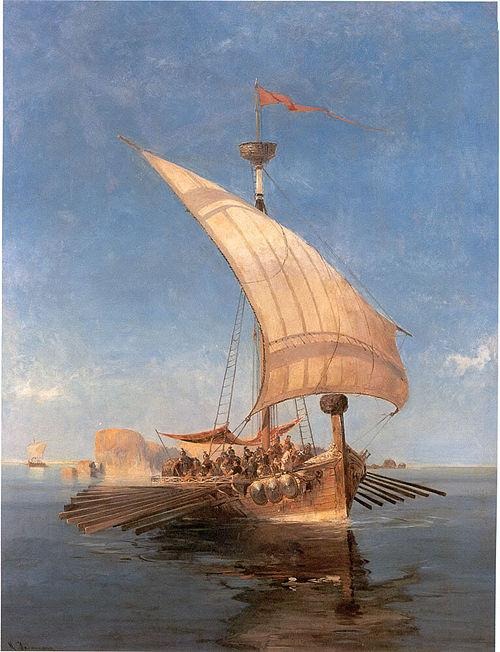
An interesting fact: the Argo program was named after the legendary ship from ancient Greek mythology on which Jason traveled. This is not just a poetic name - it symbolizes the scientific partnership between the Argo system and the Jason satellite missions. Just as the hero and the ship were inseparable in the myth, today Argo floats and Jason satellite altimeters together provide scientists with a more complete picture of the processes occurring in the world ocean.
“Garbage Continents” in the Ocean
Ocean gyres create not only stable patterns of water movement but also an unexpected consequence. Because of their circular motion, floating objects gradually gather in certain areas of the ocean. When water moves in a vast circular pattern, it acts like a giant funnel: everything that enters this system - from tiny plastic particles to larger debris - eventually ends up in its central region. There, the currents become weaker, and the debris begins to slowly accumulate. The most well-known example of this phenomenon is the Great Pacific Garbage Patch. It is located in the northern part of the Pacific Ocean within the enormous North Pacific Gyre, one of the largest ocean circulation systems on the planet.

It's estimated that between 1.15 to 2.41 million tonnes of plastic are entering the ocean each year. The Ocean Cleanup
This formation is sometimes referred to as a “garbage continent,” although it is not a solid island of waste. Rather, it is a vast area of the ocean where millions of fragments of plastic and other lightweight materials float in the water, gathered there by the movement of ocean currents.
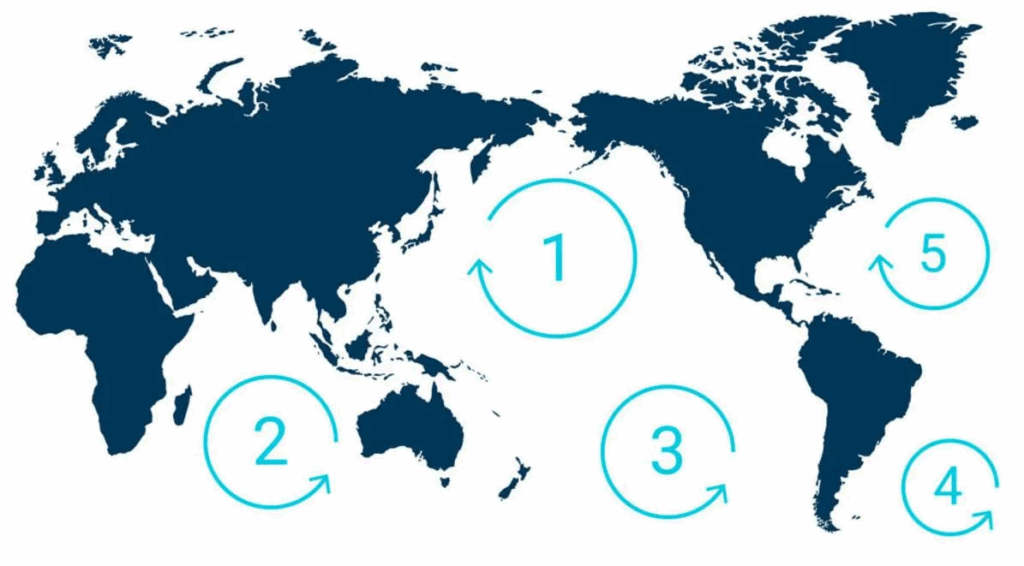
The Great Pacific Garbage Patch is the largest of the five plastic accumulation zones in the world’s oceans. The Ocean Cleanup
This example clearly demonstrates how powerful and stable ocean gyres can be. They are capable not only of transporting heat and water across thousands of kilometers but also of collecting together everything that becomes caught in their circulation.
Ocean currents are as rivers within the ocean - vast streams of water that cannot be seen from the shore, yet upon which life across the entire planet depends. They connect oceans and continents, transport heat, shape the climate, sustain ecosystems, and even influence where pollution accumulates. The deeper science explores the mysteries of these invisible rivers - from ancient oceans reconstructed through paleoceanography to modern measurements made with satellites and Argo floats - the clearer it becomes that the ocean is not merely a place filled with mysteries. It is one of the key systems that maintains Earth’s global balance.
At the same time, the ocean reminds us of the limits of human knowledge. Philosophers of science often view it as a metaphor for epistemic humility - an intellectual modesty that arises from recognizing how much remains unknown. This idea echoes Karl Popper’s view that scientific knowledge is always an approximation rather than a final truth. We understand the fundamental laws of ocean circulation, yet we are still only beginning to grasp the full complexity of this global system. Studying the ocean, therefore, is not only a path to new discoveries but also a way to better understand how closely everything on our planet is interconnected.