







In a teeming metropolis, 2 million people cram into a small area, five as densely as in modern-day London. There is no garbage collection, recycling, or sewage treatment. People take their drinking water from the same cesspools to which they dump their nightsoil. And public assistance? Nobody has heard of it. The poor live in filth, stench, and squalor, eking out a living by scavenging for coal, wood, and rags with an occasional coin or two from the corpses floating in the river, dying an early death, and ending up in mass graves.
In the cesspools lurks a killer that came from continents away long ago. It strikes out to kill tens or even hundreds, then retreating into oblivion.
Now, the killer has stricken again. Hot on its trail is an amateur detective, its old foe.
Still, the detective does not know what or who he is chasing exactly. He only has the most rudimentary tools at his disposal. No DNA tests. No criminal databases. No computer. Not even an established method of thinking. All he has are weird theories from others.
Can the detective finally catch it?
While these paragraphs sound like a blurb on the back of a Dystopian novel, they actually describe London in 1854, when cholera was on a summer killing spree, with John Snow, a renowned anesthesiologist, trying to stop it.
How did the story involve seemingly unrelated characters?
Character One: Cholera
Originated in the Indian subcontinent, cholera was brought to Britain via global trade. It found the perfect place to live and spread in the urban centers.
Because of the Industrial Revolution, the urban population had exploded in Britain since the mid-1700s. The infrastructure could not keep up; for example, London did not modernize its sewer system until the late 1850s. Working-class people packed into small spaces with no public health measures, such as garbage disposal or sewage treatment. In addition, tanneries and slaughterhouses were often set up next to residential areas. The dog manure and mercury used by tanneries and the animal blood and waste from slaughterhouses all flowed directly into cesspools of human waste.
There was poor, if any, separation between drinking water and sewage. Many houses had a cesspool under the basement, which formed from the sewers and filth seeping in from outside. When water closets, or flushable toilets, became popular, the cesspools overflowed, further contaminating the drinking water extracted from the underground sources via water pumps.
It was no wonder that a stench always permeated the working-class neighborhoods. At times, the entirety of London was enveloped in the stench. Living under unsanitary and crowded conditions, the poor were more likely to get sick and die than the rich. The widely accepted theory that the disease spreaded via bad air, or miasmas, provided a convenient explanation. Poor neighborhoods smelled worse and were filthier; therefore, the poor were less clean and more likely to die. Thus, there was not anything the government could or should do.
The acceptance of the miasma theory helped cholera thrive. Consequently, it had its first outbreak in Britain in 1831 and kept coming back.
Character Two: John Snow
Cholera, a problem for the impoverished, seemed like an odd hobby for John Snow, a high-society anesthesiologist who administered chloroform to Queen Victoria during two of her births.
Except that John Snow crossed paths with cholera long before he came into prominence.
Born to a laborer father, John Snow grew up in one of the poorest neighborhoods in York, where most of the streets were unsanitary and the river was contaminated. At the age of 19 and as a surgeon-apothecary apprentice, he first encountered cholera when helping treat patients stricken with it. Since then, he kept track of cholera outbreaks while studying to become a physician.
While Robert Hooke and Anton van Leeuwenhoek had developed microscopes that enabled scientists to see tiny organisms beyond the naked eye, the germ theory of disease had not been developed. As a result, scientists still did not have enough tools to study how cholera was transmitted.
However, Snow's work in respiration—he studied the administration of ether and chloroform to patients during surgery—gave him a unique perspective. He asked if cholera was contracted by inhaling bad air into the bloodstream, then why were its symptoms concentrated in the digestive system? Whatever caused cholera had to be some small, highly reproductive creature swallowed by its victims.
Snow helped found the Epidemiological Society of London in response to the cholera outbreak of 1849. He also published his first paper on the cause of cholera in the same year. However, the scientific community remained unconvinced, as it treated all early proponents of the germ theory with skepticism. Another pioneer was the Hungarian physician Ignaz Semmelweis, who discovered that physicians who washed their hands caused much fewer childbed fevers, or bacterial infections, in women following birth. In 1847, he called for healthcare workers in birth clinics to disinfect their hands, but was ignored for decades.
The Showdown
John Snow would get another crack at cholera in 1854.
The 1846-1860 cholera pandemic killed millions in Asia, Europe, Africa, and North America. In Great Britain alone, 23,000 died.
The outbreak in Soho, London was especially severe. In three days since 31 August, 1854, 127 people died. During the next week, three-fourths of the residents fled the area. By 10 September, more than 500 people had died.
Because John Snow hypothesized the cholera-causing agent was swallowed by the victims, he first examined chemical properties of the water. He also looked at the water under a microscope, which was gaining in poopularity and becoming standard equipment for researchers. Still, nothing.
John Snow had to come up with another way to investigate. With the help of Reverend Henry Whitehead, a maverick famous for being open-minded, he started talking with the residents and collecting data on the people who had died.
He painstakingly documented each patient, their age, name, address, cholera-related symptoms, and details of death. Then, he analyzed the data in as many ways as he could think of: comparing the death rates in different areas, the source of drinking water for each area, the number of deaths over different periods, and the death rates of the people with different occupations.
His analysis revealed that brewers were least affected by the outbreak, because they drank the ale they brewed and never water. Also, he noticed that most deaths were concentrated near Broad Street and suspected that the frequently used water pump supplied contaminated water that killed these victims.
He took the data and his analysis to the Board of Guardians of St. James’s parish, which covered Broad Street, and convinced them to remove the handle of the pump the following day.
In the end, more than 600 people were killed. While some credited John Snow for preventing more deaths, some insisted that the outbreak was in decline and removing the pump handle did not have a significant effect. More importantly, John Snow still did not uncover what caused cholera, how the outbreak started, or how it spread; as a result, many remained unconvinced of the significance of his analysis.
Epilogue
In 1855, Henry Whitehead, after an exhaustive investigation, identified the index case, or patient zero, and teased out how the outbreak started and spread. On 28 August, 1854, the baby daughter of a London policeman named Thomas Lewis and his wife Sarah became ill. Her mother washed the soiled cloth diapers in a bucket of water and tossed the water in the cesspool that lay at the front of the house. Then, the water in the cesspool contaminated the underground water for the Broad Street pump. Whitehead’s investigation provided powerful data for John Snow’s hypothesis.
However, John Snow did not live long enough to have his theory completely accepted by the public. He died of a stroke in 1858, 25 years before Robert Koch identified V. cholerae, previously discovered by Filippo Pacini in 1854, as the cause of cholera and esatblished the germ theory.
Nevertheless, John Snow’s contribution has turned out to be more far-reaching than his contemporaries—and probably also himself also—assumed. Now celebrated for establishing the mode of cholera transmission and establishing the method of preventiong, he is widely considered the founder of epidemiology, the study of how often disease occur in different groups of people and why. His methods of collecting, analyzing, and using data to push for public health measures have become standard practice for epidemiologists today.
Moreover, he created a milestone in the history of data visualization. In the second edition of On the Mode of Communication of Cholera, he included a graph.
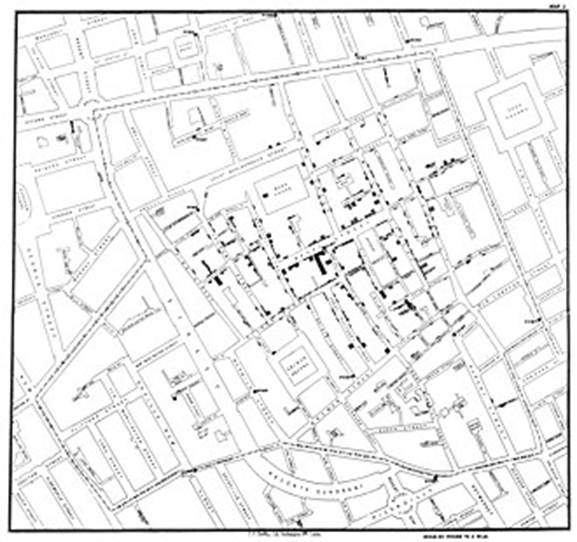
Original dot graph by John Snow showing the clusters of cholera cases (stacked rectangles) in the Broad Street Outbreak of 1854, caused by the contamination of the water pump at the crossroads of Broad Street and Cambridge Street.
While this graph looks ordinary, boring even, by modern-day standards, such data presentation was unprecedented.
Science was mainly descriptive until William Playfair, a Scottish engineer and economist, invented methods of presenting statistics. He invented the line, area, and bar charts in the late 1700s and pie charts and circle graphs in the early 1800s.
John Snow, likely influenced by Playfair’s inventions, took this a step further. He overlayed geographical data to his dot graphs to illustrate the relationship between the number of cholera-related deaths and different locations. The graph is so clear, simple, and elegant that it is included in many textbooks on data visualization.
Lastly, John Snow’s work had a lasting influence public health policy-making; sanitation, waste disposal, and water treatment have become basic requirements for the well-being of all citizens. While he only lived for 45 years, he has lived on through modern epidemiology and public health.