Another technical article today. This is the story of how ghost particles build the periodic table.
Ghosts That Forge Matter
In the final moments of a massive star’s life its iron core collapses under gravity in less than a second. Fusion halts when iron accumulates, densities soar to around \( \rho \approx 3 \times 10^{14}\,\mathrm{g/cm^3} \), and temperatures climb to tens of billions of kelvin, forming a proto-neutron star.
Remarkably, the enormous gravitational binding energy released, approximately
$$
E_{\mathrm{bind}} \approx 3 \times 10^{53}\,\mathrm{ergs},
$$
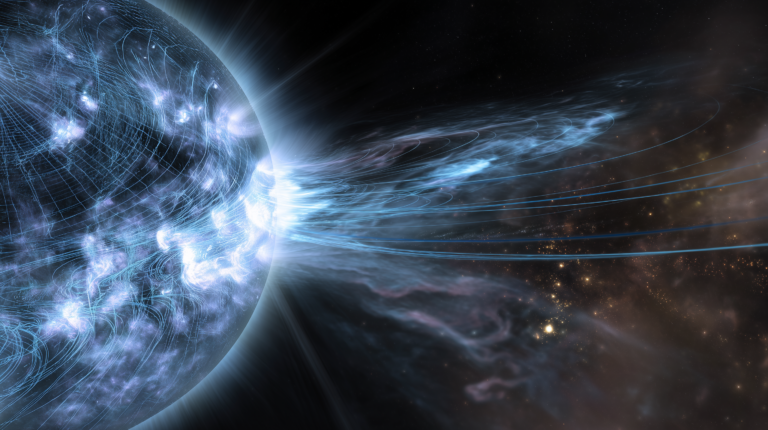
escapes primarily as neutrinos—particles that normally pass through matter unnoticed. Yet here they interact just enough to drive a neutrino-driven wind, a rapid outflow of plasma from the neutron-star surface. Within this wind, rare elements such as yttrium, strontium, and silver are forged.
The Collapse: Core Physics and Neutrino Liberation
As the iron core implodes it triggers inverse beta-decay reactions:
\( e^- + p \rightarrow n + \nu_e \)
and the reverse:
\( \nu_e + n \rightarrow p + e^- \)
The gravitational binding energy liberated when a neutron star of mass \( M_{\mathrm{NS}} \) and radius \( R_{\mathrm{NS}} \) forms is
$$
E_{\mathrm{bind}} = \frac{3}{5}\,\frac{G\,M_{\mathrm{NS}}^2}{R_{\mathrm{NS}}},
$$
where
\( G = 6.674 \times 10^{-8}\,\mathrm{cm^3\,g^{-1}\,s^{-2}} \),
\( M_{\mathrm{NS}} = 1.4\,M_\odot = 2.8 \times 10^{33}\,\mathrm{g} \),
\( R_{\mathrm{NS}} = 10^6\,\mathrm{cm} \).
Substituting yields:
This energy is radiated over about 10 seconds, giving a neutrino luminosity of
Neutrino Interactions and Electron Fraction
Key neutrino reactions:
- Electron neutrino absorption:
\( \nu_e + n \rightarrow p + e^- \) - Electron antineutrino absorption:
\( \bar{\nu}_e + p \rightarrow n + e^+ \)
These set the electron fraction \( Y_e \):
\( Y_e = \frac{n_p}{n_p + n_n} \),
where \( n_p \) and \( n_n \) are proton and neutron number densities. If \( Y_e < 0.5 \), the wind is neutron-rich \(r-process\); if \( Y_e > 0.5 \), it is proton-rich \(νp-process\).
An approximate equilibrium is:
Neutrino-Driven Wind Dynamics
The wind obeys steady, spherical hydrodynamics:
- Continuity:
\( \tfrac{d}{dr}(\rho\,v\,r^2) = 0 \;\Rightarrow\; \rho\,v\,r^2 = \dot{M} \) - Momentum:
\( v\,\tfrac{dv}{dr} = -\tfrac{1}{\rho}\,\tfrac{dP}{dr} - \tfrac{G\,M}{r^2} \) - Energy:
\( v\,\tfrac{d\epsilon}{dr} - \tfrac{P}{\rho^2}\,\tfrac{d\rho}{dr} = q_\nu \)
Here \( \epsilon \) is specific internal energy and \( q_\nu \) is the neutrino heating rate. Typical wind parameters:
- Entropy: \( s \sim 100\text{–}300\,k_B\,\text{baryon}^{-1} \)
- Expansion timescale: \( \tau_{\mathrm{exp}} \sim 10\,\mathrm{ms} \)
- Temperature: \( T \sim 1\text{–}3\,\mathrm{GK} \)
The νp-Process: Proton-Rich Element Synthesis
For \( Y_e > 0.5 \), nuclei stall at “waiting points” like \( ^{64}\mathrm{Ge} \). Antineutrino capture creates neutrons:
\( \bar{\nu}_e + p \rightarrow n + e^+ \),
allowing bypass:
\( (p,\gamma) \rightarrow (n,p) \rightarrow (p,\gamma) \),
and synthesis up to \( A \sim 90\text{–}110 \), e.g., Sr, Y, Zr, Mo.
Neutron-Rich Winds and the Weak r-Process
In some cases \( Y_e < 0.5 \), a weak r-process occurs, producing nuclei around \( A \sim 130 \) but not reaching the third peak \( A \sim 195 \). Conditions: \( Y_e \lesssim 0.4 \), \( s \gtrsim 150\,k_B \), \( \tau_{\mathrm{exp}} \lesssim 50\,\mathrm{ms} \).
Galactic Chemical Evolution
Neutrino-driven winds enrich early galaxies with first-peak r-process and p-nuclei, complementing neutron star mergers (heavy r-process), collapsars (GRBs), and magneto-rotational supernovae.
Ghost Particles, Heavy Atoms
Neutrinos, though ghostly, sculpt the cosmos in core-collapse supernovae. Their fleeting interactions in the neutrino-driven wind shape the production of rare elements crucial for planets and life.
Though silent, they are among the universe’s most profound alchemists.