- Why humans can't regrow teeth: Unlike alligators, humans only have two sets of teeth in their lifetime. Once adult teeth are lost, the cells and gene signals needed for tooth formation disappear permanently.
- Drug treatment breakthrough: Japanese researchers found that blocking the USAG-1 gene allows animals to regrow functional teeth. The drug is in human trials and could be available by 2030.
- Lab-grown alternatives: Scientists are developing "toothlets" using stem cells and hydrogels, plus exploring 3D bioprinting for custom tooth replacement, though these methods are still in early stages.
Ever wondered why humans are not continually able to regrow and replace adult teeth after losing them? While our skin, bones and other tissues in the body, regenerate and repair themselves, why not teeth?
Like most mammals, humans are diphyodonts – we possess two sets of teeth throughout our lifetime. Baby teeth or deciduous teeth act as placeholders for our permanent or adult teeth which are stronger and better adapted to chewing forces. Unfortunately, when we lose our adult teeth, we do not have another set waiting to replace them.
Wouldn’t it amazing to have shark-like or alligator-like capabilities to continuously replace teeth as they’re lost? Fun fact - alligators can replace a lost tooth up to 50 times in their lifetime. Microscopic studies of an alligator tooth revealed that under every functional tooth, a replacement tooth, and the apparatus to produce a new tooth were already present.
The Human Tooth
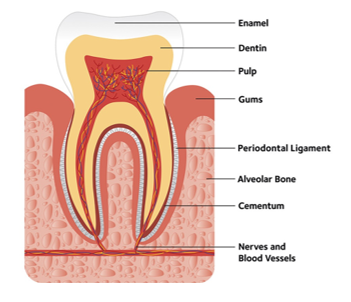
The human tooth has a visible part called the crown containing a hard outer layer enamel, a relatively hard dentin and a soft pulp containing nerves and blood vessels. Cementum and periodontal ligament connect the tooth to the jawbone surrounding it forming the root portion. Together, they give teeth the ability to withstand hard chewing forces and cushion it within the bone. Each of these individual structures are formed by specific components of the tooth bud, the structure from which a tooth is produced.
Tooth Formation
Human tooth formation is a complex process that is site-specific, time-dependent, and requires precise gene signals. At each site of a future tooth, stem cells form the dental lamina or tooth bud, which differentiates to form different cell components - ameloblasts (enamel forming), odontoblasts (dentin), dental papilla (pulp) and cementoblasts (cementum). This process is heavily dependent on complex interactions between these cells under the influence of several transcription factors and gene signals. However, these gene signals are transient and are lost once a specific component (for ex. enamel) is formed. This is one of the main reasons why humans are unable to regrow teeth lost teeth, like alligators.
However, some parts of the tooth like dentin and pulp can repair and regenerate to a limited extent, especially in response to injurious stimuli. Unfortunately, ameloblasts, the cells producing enamel, disappear once enamel is formed. Because enamel is the hardest part of the tooth and cannot naturally regenerate, whole tooth regeneration remains a challenging problem to solve.
Tooth regeneration
Replicating a complex biological process in a lab setting poses significant challenges as successful tooth regeneration depends not only on utilizing the right type of cells but also needs appropriate scaffolds and environments.
For the past few decades, multiple studies have focused on the capabilities of adult stem cells to potentially form a tooth. In the early 2000s, researchers successfully identified dental stem cells within the pulp that could, under controlled conditions, form dentin. However, further progress was hindered at the time because of the limited number of available stem cells along with the absence of suitable biomaterials.
Recently, a research group from King’s College London was able to grow “toothlets” – or toothlike structures, in the lab using a special type of material called hydrogels. This material allowed tooth-forming cells to communicate with each other, and cells were able to release tooth-forming signals slowly over a period of time, essentially mimicking the natural human tooth formation process. Their ultimate aim is to use a patient's dental stem cells to grow teeth in the lab and then implant them within the patient's jaw. While this is a promising start, more research is required to ensure that the shape and hardness of a lab-grown tooth is suitable for implantation.
A drug to regrow teeth?
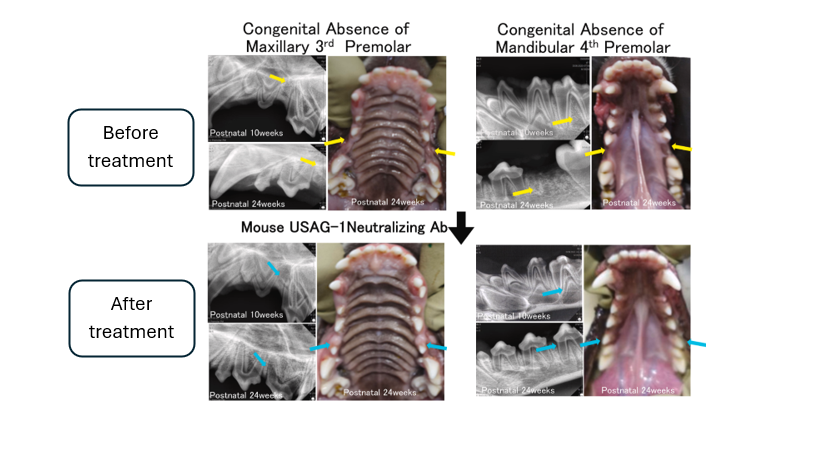
In 2021, a groundbreaking study from a Japanese group used an approach that entirely bypassed the need for a laboratory setup. While studying supernumerary or extra teeth in genetically modified mice, they identified a gene called USAG-1 which prevented the growth of new teeth. They hypothesized that blocking the USAG-1 gene would therefore promote tooth formation. Indeed, when the mice were treated with an anti-USAG-1 antibody, they were successfully able to regrow functional teeth. Furthermore, they were able to replicate these results in beagle dogs which are also diphyodonts like humans (figure below). Presently, the drug is undergoing clinical trials in human subjects and if successful, it is expected to hit the shelves by 2030.
In this scenario, using a drug is a more straightforward approach compared to lab-grown teeth which are time- and technique-sensitive. However, it remains to be seen if the drug has undesirable side effects in humans for which long-term follow-up studies are required.
3D printing of teeth
3D bioprinting has greatly advanced regenerative medicine by enabling the combination of different kinds of viable cells with biomaterials to create 3D tissues and organs. The primary advantage of 3D printing over traditional tissue engineering is the ability to customize or fabricate the exact structure of the desired tissue. From a tooth regeneration perspective, 3D bioprinting would therefore allow for formative cells to be placed in layers within a scaffold to ensure the correct shape of a tooth. Another benefit of this technology would be the potential for mass production. While still in early stages, 3D bioprinting coupled with the rapid rise of AI, appears to be an attractive option for tooth regeneration.
At the moment, most tooth regeneration strategies are focused on repairing and regenerating viable parts of the tooth such as dentin and pulp. However, it is encouraging that tooth regeneration research has progressed swiftly in two decades – from discovering the existence of dental stem cells to breakthroughs in the generation of lab-grown teeth. With the rapid progression of technology and concentrated efforts by scientists, it is only a matter of time before whole tooth regeneration becomes a reality.
SOURCES
- Yen AH, Yelick PC. (2010). Dental tissue regeneration – a mini review. https://karger.com/ger/article/57/1/85/147405/Dental-Tissue-Regeneration-A-Mini-Review
- Wu P et al. (2013). Specialized stem cell niche enables repetitive renewal of alligator teeth. https://pmc.ncbi.nlm.nih.gov/articles/PMC3670376/
- https://stemcell.keck.usc.edu/alligator-stem-cell-study-gives-clues-to-tooth-regeneration/
- Murashima-Suginami A et al. (2021). Anti–USAG-1 therapy for tooth regeneration through enhanced BMP signaling. https://www.science.org/doi/10.1126/sciadv.abf1798#sec-3
- Ravi V et al. (2023). Advances in tooth agenesis and tooth regeneration. https://www.sciencedirect.com/science/article/pii/S2352320423000044
- Takahashi K et al. (2024). Development of a new antibody drug to treat congenital tooth agenesis. https://www.sciencedirect.com/science/article/pii/S1349007924002044?via%3Dihub
- Hermans F et al. (2024). From Pluripotent Stem Cells to Organoids and Bioprinting: Recent Advances in Dental Epithelium and Ameloblast Models to Study Tooth Biology and Regeneration. https://pmc.ncbi.nlm.nih.gov/articles/PMC11222197/